

TikTok’s parent company dropped a sprawling technical report this week. Buried in the benchmarks is the clearest signal yet that the biggest AI arms race in history is being fought on your behalf—whether the combatants know it or not.
ByteDance just published the model card for Seed 2.0, the AI engine that powers Doubao—their ChatGPT competitor serving hundreds of millions of daily active users in China. Most people scrolled right past it. Tech journalists covered the sexy stuff—Seedance 2.0, the video generation model producing clips that are making Sora and Veo sweat.
But the model card is the real story. And if you’re a creator, builder, or anyone who’s been waiting for the right moment to start shipping—this is the moment the starting gun went off.
Here’s the short version: a Chinese company just matched the best AI models on the planet at roughly one-tenth the cost. And then they published the data proving it.
The giants are at war. And the spoils go to the builders.
The Price Table That Changes Everything
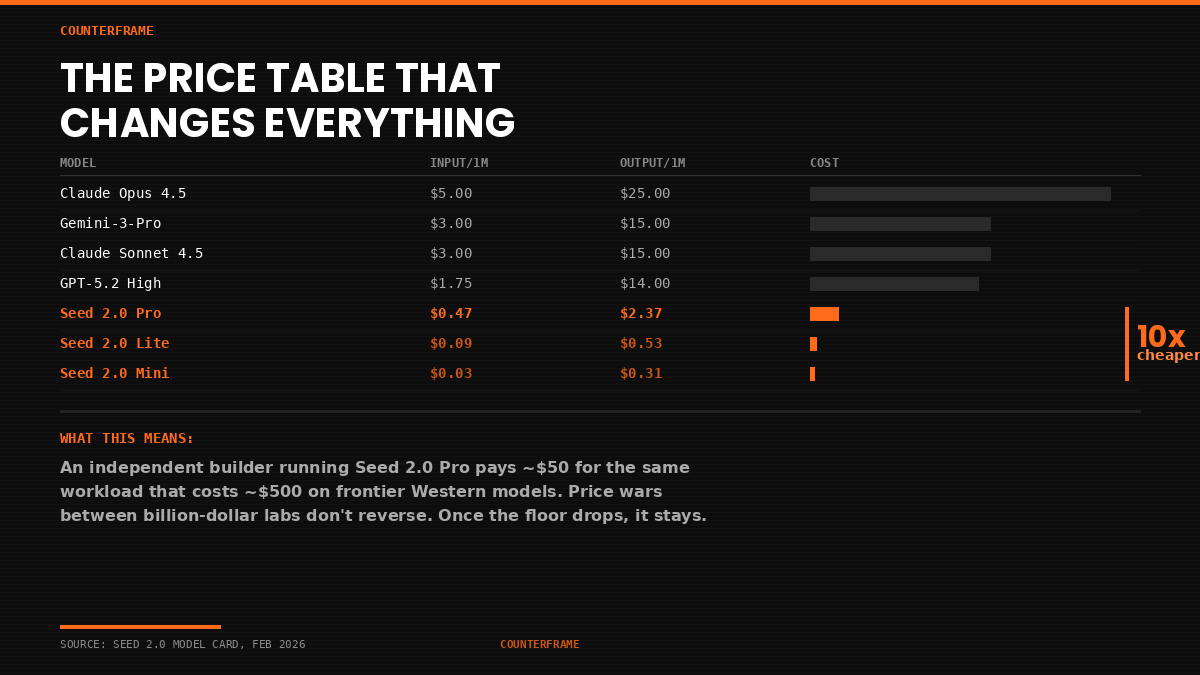
Let’s start with the number that matters most. ByteDance published a pricing comparison that should be pinned to the wall of every independent creator’s workspace:
Seed 2.0 Pro—their flagship model—costs $0.47 per million input tokens and $2.37 per million output tokens.
For context, Claude Opus 4.5 with thinking costs $5.00 input and $25.00 output. GPT-5.2 runs $1.75 and $14.00. Even Gemini-3-Pro sits in the $2-4 input range.
Seed 2.0 Pro isn’t 20% cheaper. It’s not half the price. It’s an order of magnitude less expensive than the Western frontier models. And their lightweight version, Seed 2.0 Mini? That runs at $0.03 input and $0.31 output per million tokens. Functionally free.
Now here’s the part nobody in the establishment wants you to focus on: this model isn’t cheap because it’s bad. ByteDance’s benchmarks—tested against the same standardized evaluations everyone else uses—show Seed 2.0 Pro performing on par with GPT-5.2, Claude Opus 4.5, and Gemini-3-Pro across the board. Math competitions, coding challenges, vision tasks, scientific reasoning. In several categories, it leads outright.
Same performance tier. Ten times cheaper.
That’s not a product announcement. That’s a price war. And when billion-dollar companies fight a price war over who can give you better tools for less money, there’s only one winner—and it’s not any of them.
It’s you.
The Arms Race Dividend
There’s a concept in economics called the “peace dividend”—when nations stop spending on weapons, the savings flow back to citizens. What’s happening in AI right now is the inverse. The labs are increasing their spending, fighting harder, pouring billions into the next model—and the dividend still flows to you.
Every time ByteDance publishes a model that matches OpenAI at a fraction of the cost, OpenAI has to respond. Every time Google ships a new version of Gemini, it puts pressure on Anthropic. Every time any of these companies advances, the floor drops on what it costs to access frontier intelligence.
Eighteen months ago, running serious AI workloads meant choosing between quality and your bank account. Frontier models were priced for enterprise customers with six-figure budgets. If you were an independent operator, you could dabble. You couldn’t scale.
That constraint just evaporated. And here’s the thing about price wars between giants—they don’t reverse. Once the floor drops, it stays dropped. The economics have permanently shifted in favor of the person with the idea and the willingness to execute.
You don’t need to pick a winner in this fight. You just need to keep building while the ammunition keeps getting cheaper.
What People Are Actually Building (the Data Nobody’s Talking About)
Buried deeper in the Seed 2.0 model card is something even more revealing than the pricing. ByteDance published real usage data from their enterprise platform. Not hypothetical use cases. Not pitch deck fantasies. Actual patterns from hundreds of millions of users.
The findings demolish a specific narrative the establishment loves—that AI is primarily a tool for big companies with big IT departments.
Here’s what the data actually shows:
Over 50% of agentic coding queries are frontend development. Not backend infrastructure. Not enterprise architecture. People are building user-facing applications, websites, and interfaces—the stuff that connects directly with audiences. Bug fixing dominates the task types, which means developers are using AI to maintain and ship real products, not play with prototypes.
The dominant enterprise use case is processing unstructured information. Taking messy, real-world data and turning it into structured, actionable insights. That’s exactly the kind of work that used to require an analyst team or an expensive agency. Now one person with the right AI tool handles it.
Education, content creation, and search round out the top categories. Every single one is a space where independents can compete directly with institutions—if they have access to the same caliber of tools. And as of this week, those tools cost less than your streaming subscriptions.
This isn’t a technology story. It’s a power story. The same capabilities that Fortune 500 companies are deploying at enterprise scale are now available to anyone willing to learn the workflows.
Seedance 2.0: The Director’s Chair, Delivered to Your Laptop
If the language model data is the foundation of this story, Seedance 2.0 is the exclamation point.
ByteDance simultaneously dropped what might be the most capable AI video generation model in the world. And it’s not just another text-to-video toy. Seedance 2.0 is a unified multimodal system that accepts text, images (up to nine), video clips (up to three), and audio files as inputs—then generates 4 to 15 seconds of coherent video with synchronized native audio. Physics-accurate motion. Character consistency across scenes. Lip-synced dialogue in multiple languages.
But here’s what separates this from every other video generator on the market: director-level control. Seedance 2.0 uses a reference system that lets you specify exactly what each input contributes. Upload a video for its camera movements. Upload an image for your character’s appearance. Upload audio for the rhythm. Describe the scene in natural language. The model synthesizes all of it into a single coherent output—replicating Hitchcock zooms, choreographed action sequences, beat-synced editing cuts, and one-take continuity shots.
This isn’t “type a prompt and hope for the best.” This is a production workflow compressed into a single tool. The kind of shot planning, motion direction, and multi-reference editing that used to require a director, a DP, and a post-production team.
Think about what that means for the creator who’s been told they need a production budget, a crew, and a pipeline to compete with established players. Seedance 2.0 doesn’t lower that barrier. It removes it from the conversation entirely.
And here’s the kicker—ByteDance isn’t even the only one at this level. Google’s Veo, OpenAI’s Sora, and a wave of open-source models are all converging on similar capabilities. When multiple companies are racing to give you studio-grade video tools at commodity pricing, the only question left is what you’re going to make with them.
The Honest Self-Assessment (and Why It Matters)
Here’s something you almost never see from the establishment: transparency about limitations.
Right in the model card, ByteDance openly states that Seed 2.0 has “considerable gaps with Claude in terms of coding” and “relatively obvious gaps with Gemini in terms of long-tail knowledge.” They published benchmark numbers showing exactly where they trail.
Why does this matter for builders?
Because it reveals the competitive dynamic that’s driving this entire revolution. When the biggest AI labs in the world are publicly competing on performance, transparently acknowledging each other’s strengths, and racing to close gaps—that’s not just corporate posturing. That’s an innovation engine running at full throttle with your benefit as the output.
The honest self-assessment also tells you something practical: you don’t have to go all-in on one tool. The smart play is to understand what each model does best and use them accordingly. ByteDance for cost-effective scale. Claude for complex coding. Gemini for deep knowledge retrieval. The fact that you even have this kind of menu—frontier models competing for your attention at plummeting prices—would have been unimaginable two years ago.
What This Means for You

If you’re a creator, a builder, someone with ideas who’s been told the tools are too expensive or the playing field too tilted—here’s what ByteDance’s model card actually means for your life:
The cost objection is dead. Frontier-level AI intelligence is available at prices that would have been unthinkable 18 months ago. Whether you use Seed 2.0 directly or just benefit from the downward price pressure it puts on every other provider, the economics permanently shifted in your favor this week.
The skills gap is closing fast. When over half of coding queries are frontend development and bug fixing, that tells you where value is moving. You don’t need a CS degree to build something people use. You need an idea, a willingness to iterate, and tools that just got dramatically more accessible.
Video production is no longer a gated discipline. Between Seedance 2.0’s multimodal reference system, Google’s Veo, OpenAI’s Sora, and the open-source wave behind them—the premise that you need professional production capabilities to create compelling video is officially a relic. If you have reference footage, a character image, and a concept, you can direct scenes that would have required a crew last year.
The giants are fighting. Collect the dividend. You don’t need to care whether ByteDance beats OpenAI or Google beats both. Every round of this fight produces better, cheaper tools that land directly in your hands. The only losing strategy is sitting on the sidelines waiting for a winner to be declared.
The people who understand this moment—who see the pricing data, the convergence, the arms race dividend—are already building. They’re shipping products, launching channels, creating content, standing up businesses. Not because they got permission from anyone. Because the tools finally caught up to the ambition.
The receipts are public. The prices are posted. The tools work.
What are you going to build?
CounterFrame is the field guide for the populist content revolution. If this piece resonated, subscribe for the strategies, tools, and case studies that help builders ship without permission.