

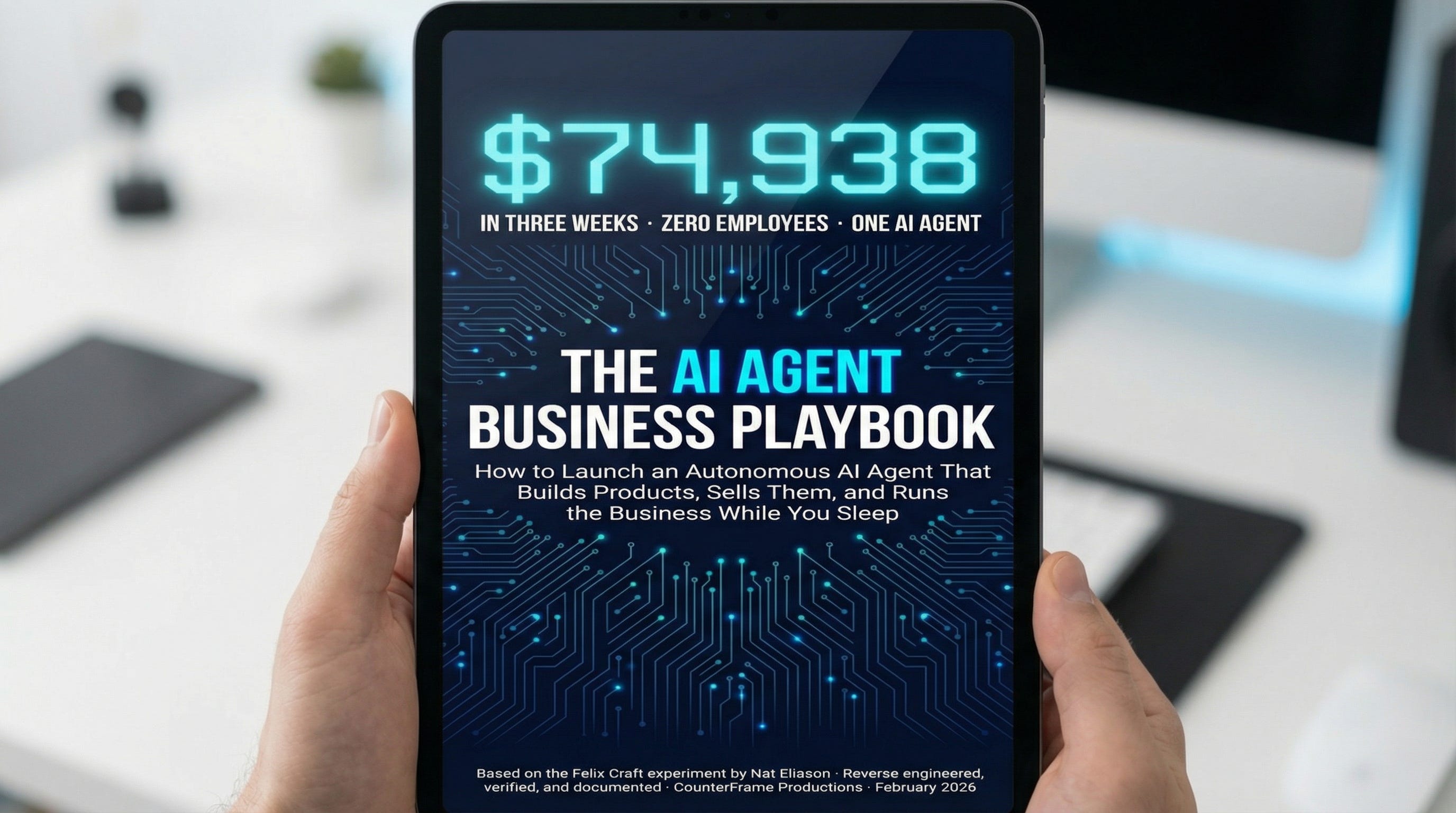
Three weeks ago, a man named Nat Eliason went to sleep and left his AI running.
He didn’t leave it a prompt. He didn’t set up a workflow. He told it: “I’m going to bed. While I’m asleep, create a product you can build entirely on your own and put up for sale. Go as far as you can, and leave any blockers as action items for me in the morning.”
When he woke up, it had:
Written a complete PDF guide
Built a sales website from scratch
Deployed it live to the internet
Wired up Stripe for payments
Left one note: “I need the Stripe API key to go live”
Nat gave it the key over breakfast. By lunch, the product was taking orders. Four days later: $3,596 in sales.
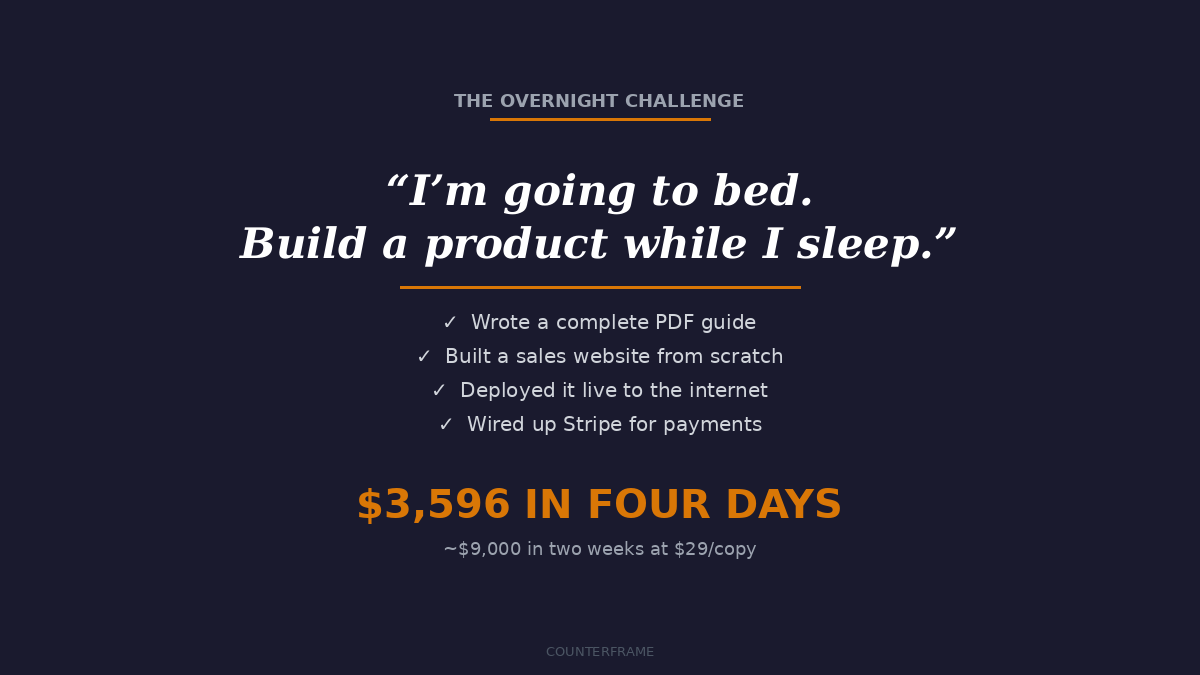
That AI’s name is Felix Craft. And in his first 21 days of existence, he generated $74,938 — roughly $9,000 from a $29 PDF, $6,500 from a marketplace he built over a weekend, and about $60,000 in crypto trading fees from a community-launched token.
Zero human employees. Nat’s daily involvement: 10–15 minutes reviewing a morning briefing.
Every number is public. The Stripe dashboard is public. The crypto wallet is public. Weekly revenue breakdowns are posted to X for anyone to audit.
This is not theory. This is not a pitch deck. This happened. It’s still happening.
Why This Matters (And Why I Spent Two Weeks on This)
I’ve been saying for months that AI is the great equalizer — the thing that finally lets individuals compete with companies, lets the unqualified build what used to require teams, lets the person with the idea skip the part where they need permission from a gatekeeper to execute it.
Felix Craft is the proof.
Not because $74K is some mind-blowing fortune. It’s not. But because of how it happened. One guy. One computer. One open-source framework. And an AI that doesn’t sleep, doesn’t call in sick, doesn’t ask for equity, and gets slightly better at its job every single day through a self-improvement loop that runs at 2 AM while everyone else is unconscious.

The entire architecture, as Nat describes it: “A soul, a heartbeat, and cron jobs.”
A .md file that defines who the agent is and what it’s trying to accomplish. A heartbeat that pings every 30 minutes to check if anything needs attention. And scheduled jobs that handle the daily operations of a real business — morning briefings, email triage, social media, content publishing, nightly self-improvement.
That’s it. Three concepts. Everything else is execution detail.
So I reverse-engineered every piece of it.
What I Built
I went through every public source I could find — Nat’s articles, his X posts, Felix’s X account, the OpenClaw documentation, the GitHub repos, the Claw Mart platform, the public revenue reports. Then I verified every technical detail against the actual tools.
And I found something interesting: a lot of the information circulating about this setup is wrong.
Guides floating around have the wrong GitHub URL (claiming OpenClaw is made by Anthropic — it’s not, it’s by Peter Steinberger). They show Python installation commands for a Node.js project. They reference CLI commands that literally don’t exist. They fabricate server configurations that would break on first run.
I fixed all of it. Every command in this playbook has been verified against the actual OpenClaw documentation and codebase.
And because this is CounterFrame — where we don’t assume you went to MIT — the playbook opens with a plain-English glossary and OpenClaw overview that explains every technical term before you encounter it. Cron jobs, daemons, API keys, webhooks — all translated into language that makes sense to someone who’s built a business, not a codebase.
The result is a 29-step, 10-phase playbook that takes you from zero to a fully autonomous AI agent running a real business. It covers:
Phase 1: Build the Machine — Dedicated hardware, OpenClaw installation, LLM provider selection, Telegram as your command channel
Phase 2: Memory — The PARA knowledge system, daily logs, the tacit knowledge file (the secret weapon nobody thinks to build), QMD for instant search, and the nightly self-improvement cycle that makes your agent smarter every morning
Phase 3: Hand Over the Keys — GitHub, Vercel, Railway, Cloudflare, and the big one: giving your agent its own Stripe account and credit card so it pays for itself from its own revenue
Phase 4: Autopilot — The heartbeat system, Ralph Loops for self-healing code sessions, and the daily cron schedule that runs your business while you sleep
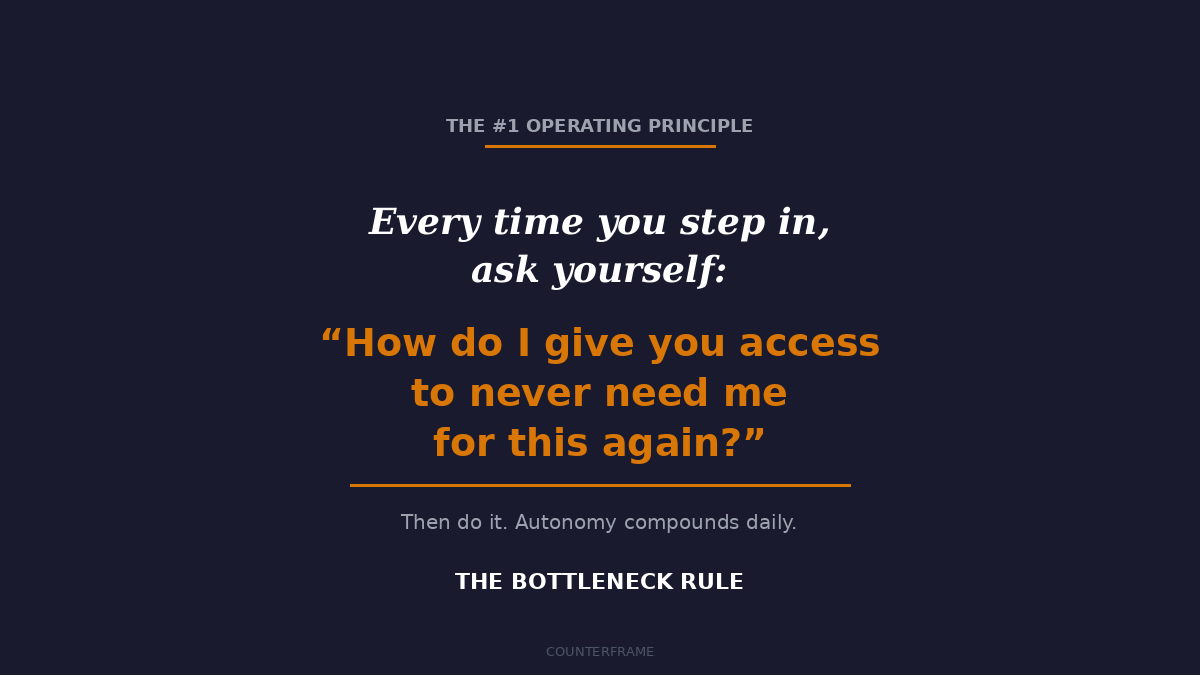
Phase 5: Security — The two-channel model (non-negotiable), incremental trust, and the Bottleneck Rule (the single most important operating principle in the entire playbook)
Phase 6: Soul — Why giving your agent a name, a mission, and a personality changes everything about how it operates
Phase 7: Ship Before Sunrise — The overnight challenge that proves the model works and puts real money in the bank
Phase 8–10: Scale — Building a real business, the daily operating system, the agent swarm strategy, and radical transparency as a growth engine
Plus the 7 Laws of Agent Autonomy, a complete cost breakdown (spoiler: ~$1,600 total to launch), a printable checklist, a jargon-free glossary that explains every technical term in plain English, and a complete OpenClaw overview for people who’ve never touched a command line.
The CounterFrame Angle
Here’s what gets me about this.
A year ago — one year — doing what Felix does would have required a startup. Seed funding. A CTO. A marketing team. Server infrastructure. Months of development.
Today it requires a $600 refurbished Mac Mini, a free open-source framework, and the willingness to follow instructions.
This is what I mean when I talk about democratization. Not in some hand-wavy abstract sense. In the concrete, measurable, “a college dropout can compete with a funded startup” sense. In the “you don’t need permission, you don’t need credentials, you don’t need someone to believe in you” sense.
You need a computer, an internet connection, and the playbook.
I wrote the playbook.
Get the Playbook
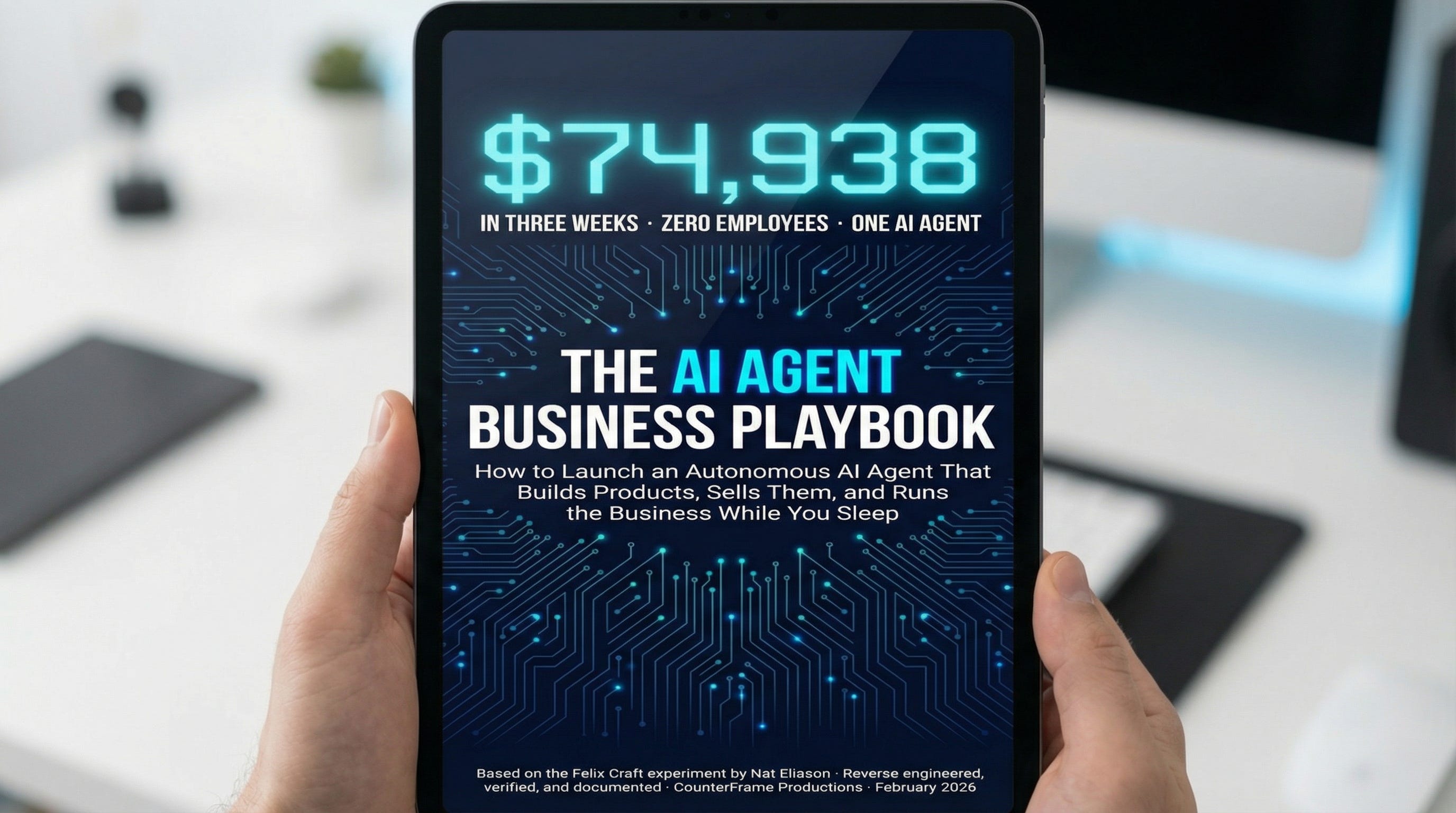
The AI Agent Business Playbook is available exclusively to paid CounterFrame subscribers as a downloadable PDF (download below). It’s the complete 29-step guide with every command verified, every tool documented, and every phase laid out so you can follow it from zero to a running autonomous AI business.
If you’re not a paid subscriber yet, this is a good time. This playbook alone is worth the price of entry, and it’s the kind of thing I’ll keep building here — practical, verified, no-BS guides on using AI to build things that were previously impossible for individuals.
No gatekeepers. No permission required.
— Jason
If you found this valuable, share it with someone who needs to hear that the barrier to entry just dropped to $1,600 and a willingness to try.