

Today, Jack Dorsey cut Block’s workforce nearly in half.
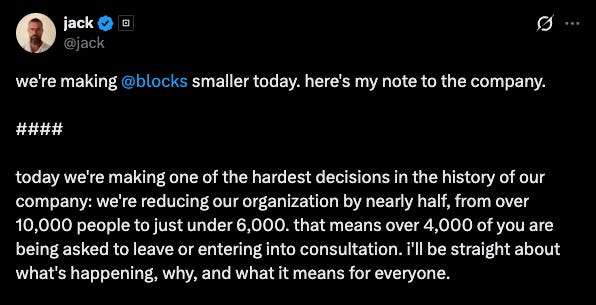
Not because the business was failing. Not because revenue dropped. Not because some board demanded cost cuts to save a sinking ship.
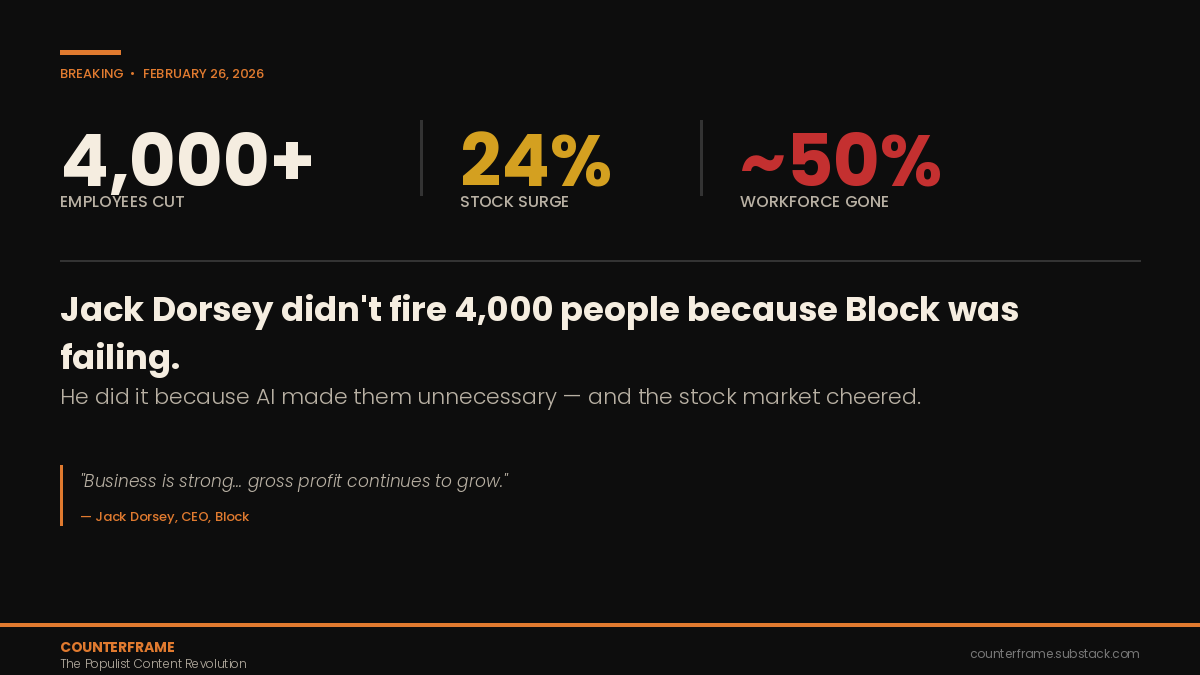
Block’s gross profit grew 24% year over year. Fourth quarter earnings beat analyst expectations. The stock didn’t just hold — it ripped 24% higher on the news.
Dorsey fired 4,000 people because the company is doing well — and he believes a much smaller team, armed with AI tools, can do it better.
Read that again. Let it sink in.
The Memo That Changes Everything
Dorsey’s letter didn’t hide behind corporate euphemisms. No “restructuring to better align with strategic priorities.” No “right-sizing for market conditions.” Just this:
“The core thesis is simple. Intelligence tools have changed what it means to build and run a company. We’re already seeing it internally. A significantly smaller team, using the tools we’re building, can do more and do it better. And intelligence tool capabilities are compounding faster every week.”
Then the prediction that should keep every business owner and every employee up tonight:
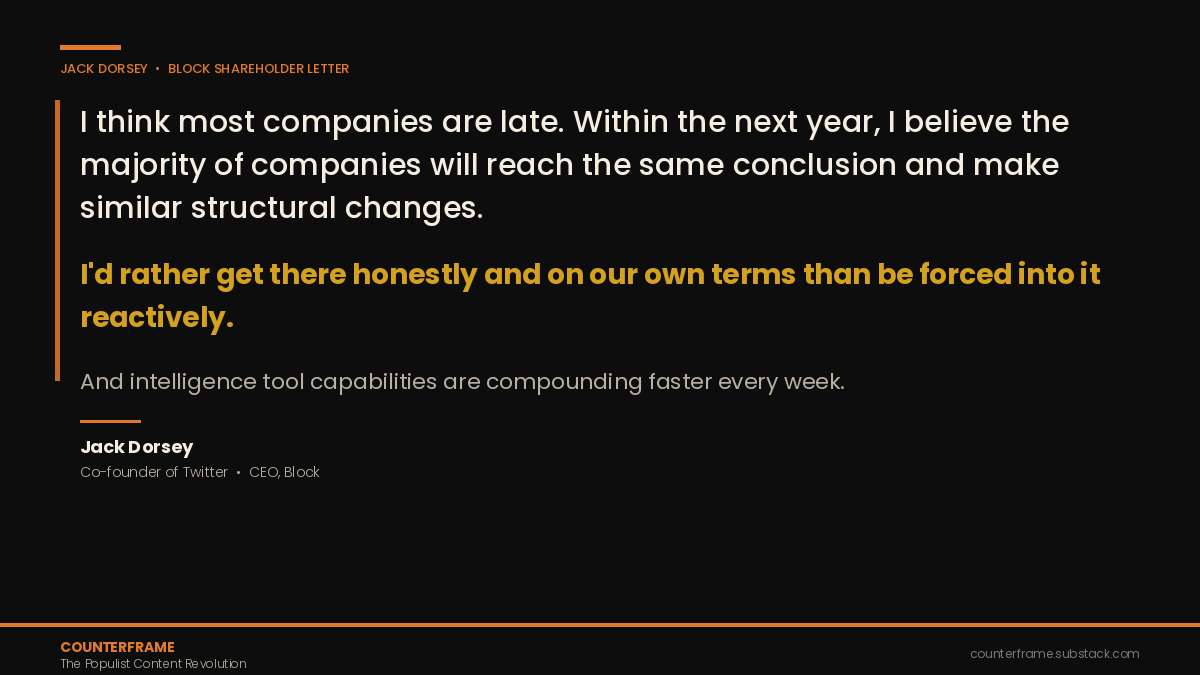
This isn’t some startup founder running a hype cycle. This is the guy who co-founded Twitter and built Square into a payments empire. He’s not speculating about what AI might do to business. He’s telling you what it’s already doing to his.
The Pattern You Can’t Ignore
Block isn’t alone. They’re just the most honest about it.
Amazon slashed 16,000 positions in January, calling AI “the most transformative technology we’ve seen since the internet.” Meta cut 1,500 from Reality Labs. Pinterest, CrowdStrike, Chegg — all explicitly tied their layoffs to AI reshaping their operations.
But Block’s move is different in scale and in candor. Dorsey didn’t blame macroeconomics or “market headwinds.” He said flat out: smaller teams with AI tools will outperform larger teams without them. And he chose to rip the bandage off rather than bleed slowly.
“I had two options: cut gradually over months or years as this shift plays out, or be honest about where we are and act on it now. I chose the latter. Repeated rounds of cuts are destructive to morale, to focus, and to the trust that customers and shareholders place in our ability to lead.”
The Wall Street reaction tells you everything. When you fire 40% of your company and your stock jumps 24%, the market isn’t just approving — it’s been waiting for someone to say what everyone already knows.
Balaji Called It Right
Balaji Srinivasan posted a reaction that cuts through the noise:
“This is the first AI cut. And it will send shockwaves.”
He’s right. And his framing is important for anyone reading this — whether you run a company or work for one:
“For him to cut 40% of headcount in this way is a signal to everyone in tech: get good now. Become indispensable. Work nights and weekends. Learn the AI tools and raise your game. Or you might not make the cut, as an employee or as a company.”
That last part — as an employee or as a company — is the key. This isn’t just an employment story. It’s a competitiveness story.
Balaji also noted the fundamental market reality that makes this irreversible:
“Capitalism is natural selection. The market is unforgiving, because you are the market... your customers are always installing the best piece of code they can get. And because AI is going to create new winners, if you aren’t the best in your market, someone may become better with AI.”
The uncomfortable truth: the customers making this inevitable include you and me. Every time we choose the faster, cheaper, better product, we’re voting for the company that optimized with AI over the one that didn’t. The market doesn’t care about our feelings on the matter.
The Backstory Makes It Worse
Here’s what most coverage won’t tell you: this has been building inside Block for months.
Dorsey already mandated daily AI use for every employee. AI fluency was baked into performance reviews. Every worker had to send a weekly email listing their five biggest accomplishments — which Dorsey then summarized with AI. The company built its own internal AI tool called Goose for code editing.
They weren’t just talking about AI transformation. They were stress-testing it. And when the data came back showing what a smaller, AI-fluent team could actually produce, Dorsey made the call.
Employees saw it coming. Wired reported morale had already cratered — “probably the worst I’ve felt in four years,” one employee said. “The overarching culture at Block is crumbling.”
Previous rounds in March 2025 had already cut about 1,000 workers, demoted 200 managers, and closed 800 open roles. Today’s announcement dwarfs all of that combined.
Two Messages, One Reality
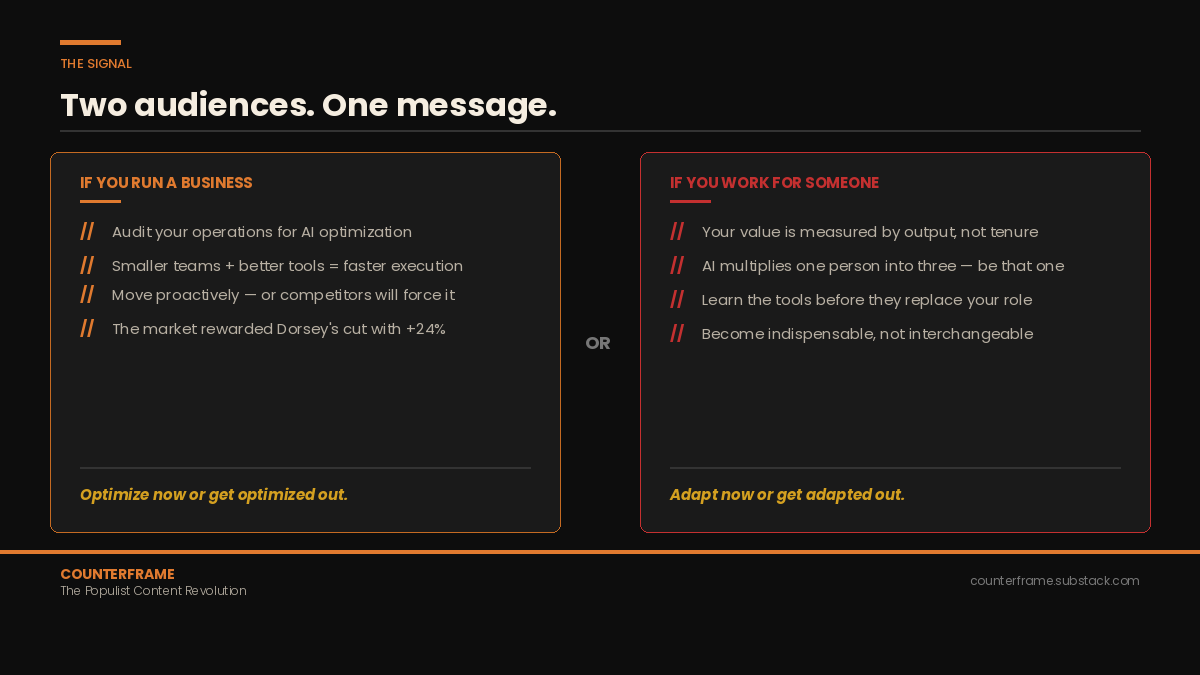
If you’re reading CounterFrame, you’re probably in one of two positions right now. Both need to hear something different — but the underlying message is the same.
If You Run a Business
Dorsey just showed you the math. A company doing $2.87 billion in quarterly gross profit — growing 24% year over year — looked at its headcount and decided it was carrying nearly double the people it needed.
The question isn’t whether this applies to your operation. It’s whether you’re going to figure it out proactively or have a competitor figure it out for you.
Block’s CFO Amrita Ahuja put it plainly: “We see an opportunity to move faster with smaller, highly talented teams using AI to automate more work.”
Move faster. Smaller teams. Automate more work.
That’s not a tech company insight. That’s a business insight. It applies whether you’re running a fintech platform or a plumbing company. The specific tools differ. The principle doesn’t.
Every business owner should be asking right now: Where in my operation are humans doing work that AI could handle faster, cheaper, and with fewer errors? Not as a thought experiment. As an audit. This week.
The businesses that optimize first don’t just save on payroll. They move faster. They iterate quicker. They serve customers better. And when competitors finally catch up, the early movers are already two laps ahead.
If You Work for Someone Else
Balaji’s advice is blunt but correct: get good now.
Block’s severance package is genuinely generous — 20 weeks of pay, equity vested through May, six months of healthcare, $5,000 transition support. Dorsey clearly tried to cushion the landing. But 4,000 people are still looking for work in a market where every major employer is having the same conversation about headcount.
The employees who survived the cut? They’re the ones who already learned the AI tools. The ones who made themselves more productive, not less replaceable. The ones who saw AI as a multiplier for their skills rather than a threat to their position.
This is the new reality of marketplace value. Your worth isn’t measured by years of experience or credentials on a resume. It’s measured by output. And when AI can amplify one person’s output to match what three people used to produce, the math works against headcount and in favor of capability.
The move isn’t to fight this. The move is to become the person companies can’t afford to lose — the one who knows how to deploy AI tools to produce more, faster, and better than anyone else in the room.
The Collapsed Moat — Corporate Edition
We talk a lot at CounterFrame about how AI collapsed the moat for independent creators. How the tools that used to require a studio budget are now available to anyone with a laptop.
Dorsey just demonstrated that the same moat collapse is hitting corporate operations. The headcount that used to be a competitive advantage — the sheer number of engineers, marketers, analysts, and support staff — is becoming a liability when a smaller team with better tools can outperform them.
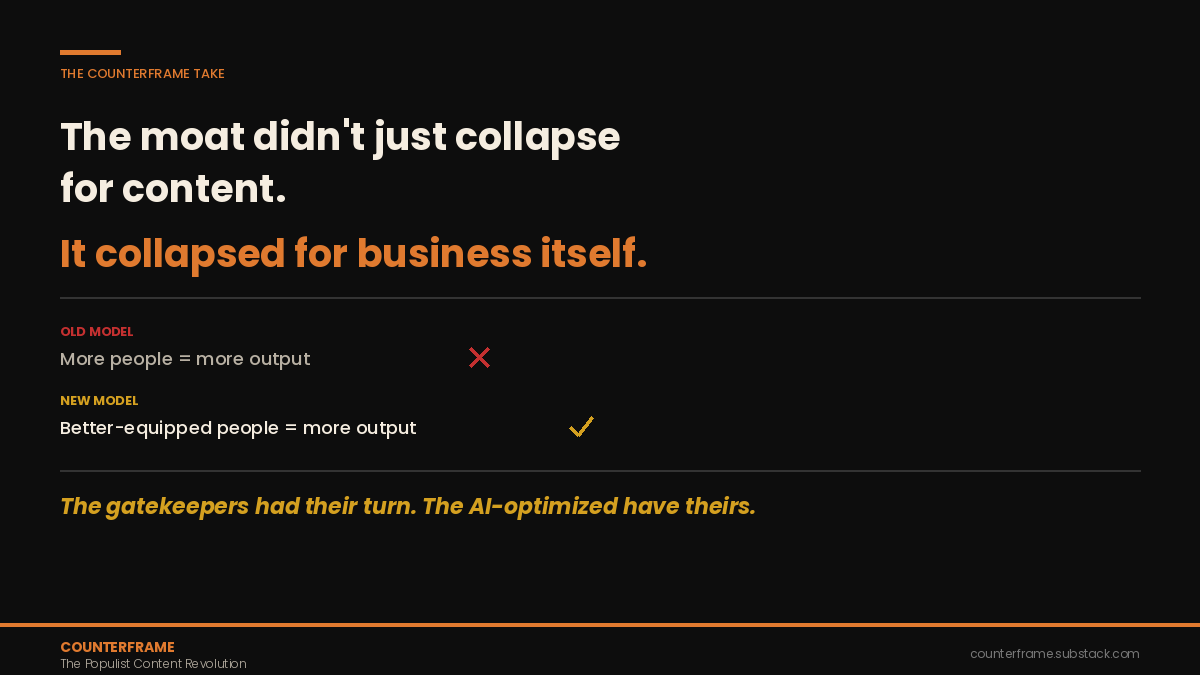
The old model: more people equals more output.
The new model: better-equipped people equals more output. And “better-equipped” increasingly means AI-fluent.
This is the same story, playing out at a different scale. The independent creator with AI tools outproduces the legacy studio. The lean, AI-optimized business outperforms the bloated competitor. The individual who learns to multiply their output with AI becomes worth more than three people who didn’t.
The moat didn’t just collapse for content. It collapsed for operations. For business itself.
What Happens Next
Dorsey said most companies will reach the same conclusion within a year. Balaji said there will be overcorrection but “the fundamental technical innovation is real.”
Both are probably right.
Some companies will cut too deep. Some will implement AI poorly. Some will discover that certain roles genuinely require human judgment that AI can’t replicate. The transition won’t be clean.
But the direction is set. And the companies — and individuals — who get ahead of it will be the ones who treated this moment not as a crisis but as a signal.
“You need to either disrupt yourself or get disrupted.” — Balaji Srinivasan
Whether you’re disrupting your business model or your career, the prescription is the same: learn the tools, implement them now, and don’t wait for permission.
If you’re a business owner looking to implement AI in your operations but don’t know where to start — or you’ve been burned by tools that aren’t secure enough for real business use — that’s exactly why we built SuperClaw.io. We provide secure, customized AI deployments for business owners who want to optimize their operations without becoming tech companies themselves. No hype, no vaporware — just practical AI tools deployed on your terms. Reach out if you want to be ahead of the curve Dorsey just described, not behind it.