


I was sitting next to someone who had seen very little AI content before.
Her husband is a traditional film director. She was an AI skeptic, which is where most people still are on this stuff.
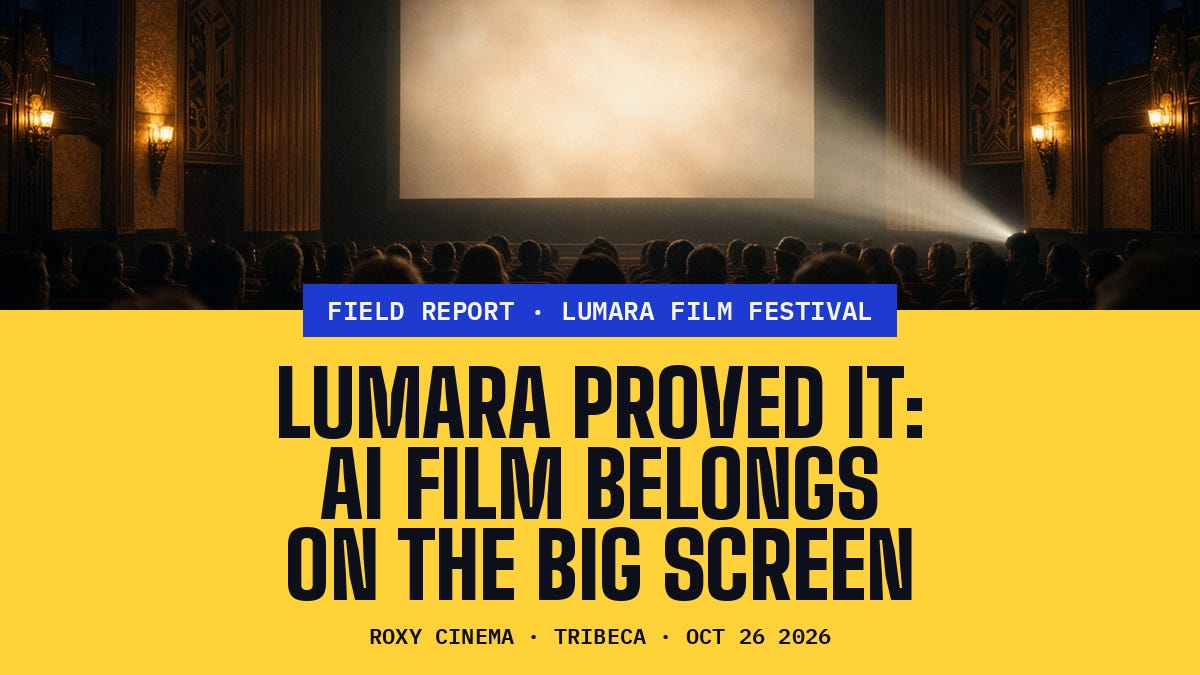
Then the lights went down at the Roxy Cinema in Tribeca and the films started.
After seeing the work of Ryan Lightbourn and others, she turned to me and said:
“I was blown away.”
When we talked about it afterward, she told me the one she would go watch was PAYOLA, the new film from Heavy Pulp. She had only seen the trailer.
That reaction is the whole story of the night for me. The vast majority of people have never seen high quality, story-driven AI films. When they do, they react the way she did.
My bet is that 2027 is the year AI content breaks into the mainstream, because the quality got good. Really good. Monday night proved it.
What Lumara is


The Lumara Film Festival calls itself “an independent film festival for the artists defining a new era of filmmaking.” It was presented by Venice and MoonPay, and this was the first one.
Entry was free and open worldwide, and you could use any AI tool you wanted. More than 700 films came in. Venice told one finalist it was 732, and Venice founder Erik Voorhees put it closer to 750 on CoinDesk. He said most of them came “from amateurs and small teams.”
Amateurs and small teams made the films that blew away the skeptic sitting next to me.
The jury scored three things, in this order: the strength of the idea, the quality of the storytelling, and how well the filmmaker used AI. The tools came last.
There was real money on the table, around $100K in cash plus Venice credits, with $32,000 for the Grand Prize.
Thanks again to Venice for the invite. Shout out to Jesse Proudman, Jon and Lorenzo on the Venice side for putting together a night that felt like a real premiere.
The night
Six finalists and five category winners screened in full on a real cinema screen in New York, and the top two prizes were announced live in the room.
A film on your phone is a clip. A film on a big screen, in the dark, with a room full of strangers reacting at the same time, is cinema. These films held up there.
Lorenzo from Venice told Chris Capel about his film, “it plays amazingly in a theater.”
The jury brought new work too. We got to see an extended prologue from Gossip Goblin‘s upcoming film Gods Don’t Give Gifts, which MoonPay’s finalist announcement says is slated for a wide theatrical release at the end of this year.
Heavy Pulp showed the trailer for his new one, PAYOLA, and it’s the one that sold my skeptic neighbor. He posted a sneak peek the next morning. I already reposted it. You should watch it.
Then there was the reception afterwards. I stayed much too late. 🥃
The winners
Grand Prize: CANDY by Jiaze Li

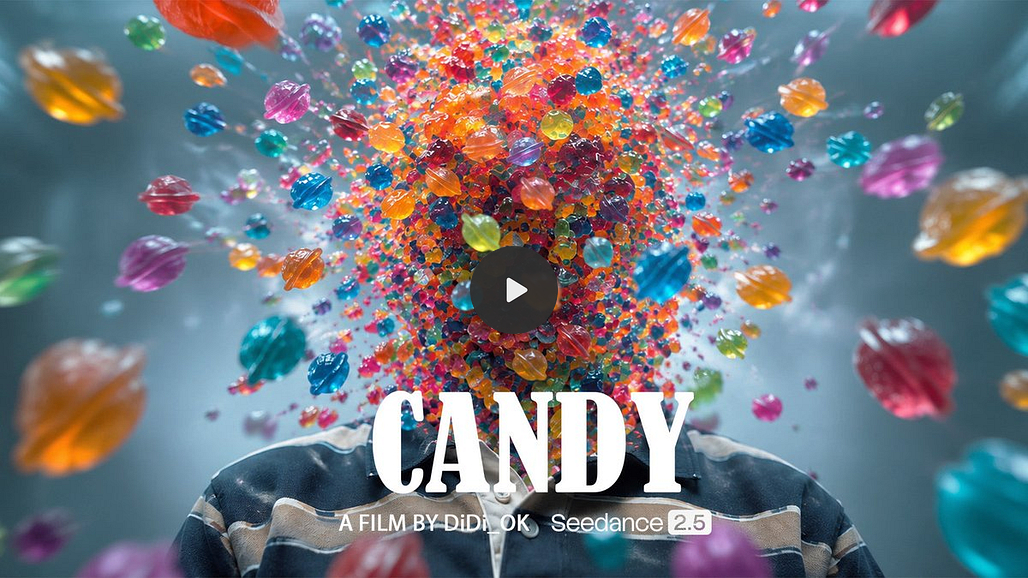
Jiaze Li took the top prize with CANDY (YouTube).
The premise is a great one. In the future, anyone who hurts someone turns into candy. Jiaze’s own question: “Would that make us civilised?”
It runs about nine minutes and was made with Seedance 2.5, in collaboration with BytePlus. His original post on X has passed a million views. His first line is, I think, the thesis of this whole movement:
“Our bet is that better AI will make films more personal.”
Jury Selection: Mianmian by Yingjie Chen
The runner-up prize went to Mianmian by Yingjie Chen. Out of 700+ films, it finished second.
The category winners
Venice and MoonPay revealed these one per day in the week before the screening.
Serenissima Award (best film made with Venice): Black Thunder by Ryan Lightbourn. It’s a 12-minute sci-fi fantasy epic, and it was also a Grand Prize finalist. Ryan says he made it for $2,000. Hollywood spent $200 million on He-Man. Ryan also told everyone the algorithm chase makes films worse, so he went the other way and gave his films a story. Black Thunder and his film Rainbow Girl are now past 3.5 million views across socials.

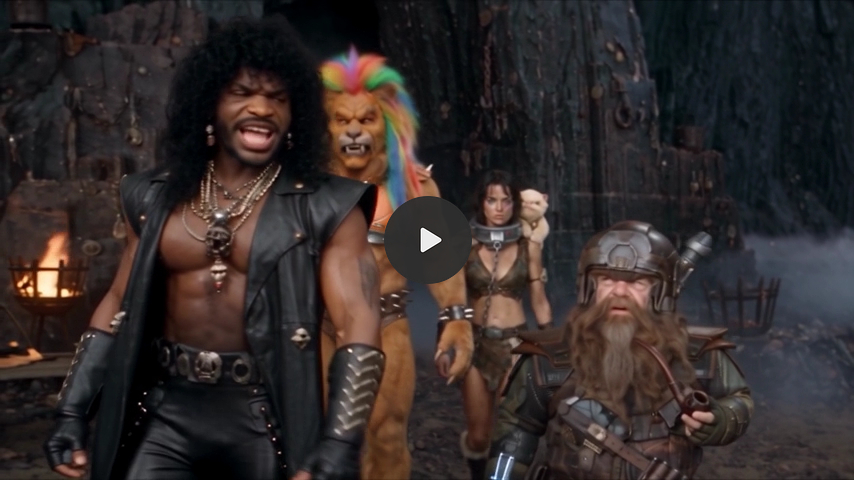
Terminal Award (best experimental film): REVIVER by Aleksey Dor of The Dor Brothers. It’s a 13-minute visual feast that spans thousands of years of human existence.
Get Shorty Award (best film under two minutes): Ato de [Later] by Luke Mazey of Slophouse. A son keeps telling his mother “later.” Two minutes, first person, and it hits hard. Luke wrote, directed and produced it solo.
Mouse Award (best film for young audiences): FIX by Eunha Lee, Sora Lee and Hakhoon Lee. It’s an animated coming-of-age musical.
Rekt Award (best film about finance or crypto): JUST SAY SOLANA by Yassine Le Gall, aka HOON. It’s a four-minute prehistoric time-travel adventure. Yes, a crypto festival category, because MoonPay was a presenter. The craft is what got it on screen. HOON also posted a clip from inside the Roxy with a caption I love: “In 2026, AI films are screening in cinemas.”
The rest of the finalists
Six films made the final cut out of 700+. Here are the other three:
Gabriel by T Zhang, aka Gertywood. He’s a former ABC Network staff writer, so this is a traditional Hollywood writer making AI films.
Killabears: The Broadcast by Mikael Tyrsen. Venice’s advice: “Maybe you should watch it with the lights on.”
Living with a Merman by Chris Capel. Venice’s tagline: “The title is not a metaphor.” Chris’s reaction to making the final six: “6 out of 700+. Craziness.”
Nominees and honorable mentions worth your time
I want to name as many of these filmmakers as I can, because every one of them beat out hundreds of other entries.
Terminal Award nominees: Stories My Great Great Great Grandmother Told Me by Philippe Noguchi and THE LAST TRIBE by Stephane Benini.
Serenissima Award nominees: Marco Magario for Er Loop, and Allan Ecax for Never Forget. Marco gave his film away free, no ads, no paywall, and asked people to share it if it gave them something.
Get Shorty Award nominees: COMPULSION by Gyuseon Lee, Do Not Disturb by Adrian Daniel Botnariu, and Summer Afternoon, July 1994 by Charlie Park.
Mouse Award nominees: Far away home by Siping Song, and Roraima by Ishan Devare Modi with SamyazaSpeaks.
Rekt Award nominees: Great Pepe Wars by Aiden Guo, and ROLL EVERYTHING by Ashanth Phillips.
Honorable mentions: Venice called these “films with a unique voice or vision” (full list).
A Single Drop by Ki Hyoung Oh
Atlas by Samuel J Tesh
CYCLE by Baba Brouk and George Alvarezzo of Tinseltown Pixels
HAPPYPILLZ by Fatty Bagz
Never Forget by PsyopAnime
Never too late to be early. by Vincenzo Maietta, aka AI Bald King
PSYCLOPS ODDASEE by Goat Cigs
Query by Brent Charles Bonacorso
Roadtrips by Gabriela Cardona
The Alliance by Jordan Daniel Chesney
The Fog Line by Maximilian Kempe
The Reclaiming by Lukas Nowacki
THE SAINT OF THE PIT by Farid Angar
THE WALKERS by Marcel Rutschmann, aka DJ MARCELLL
Tuesday by Marcus Achtnicht
Two Fwnds by xdeconstructed
WASSIE: Respawn by Wassie Studios
One more. Emily Youcis submitted Someone To Watch Over Me, made with help from bone‘s Slop Cannon. It didn’t make the official selection, but it has pulled 188K views on X.
The jury
Look at who judged this thing:
Chris White, executive producer of Backrooms, the A24 horror hit that, per the festival site, had the biggest debut in A24 history and grossed more than $393 million worldwide.
Heavy Pulp (David Thompson), a director, editor and VFX artist whose credits include Black Panther, Venom 2 and Ant-Man and the Wasp, plus music videos for Billie Eilish, Taylor Swift and Travis Scott.
SÜNDERMANN (Maarten Sündermann), a two-time Cannes Lions Gold winner who has worked with A$AP Rocky, Lady Gaga, Tilda Swinton and Paul McCartney.
Voidstomper (Joshua Harvey), the artist Dazed credited with “AI horrorcore,” with billions of views across 8 million plus followers.
Gossip Goblin (Zack London), the writer, illustrator and filmmaker the press has called the “George Lucas of AI.”
JBoogxCreative (Tyler Bernabe), with 500 million plus views and AI work for Will Smith, Wu-Tang Clan, Grimes and Coachella.
BLVCKL!GHT, creator of the Route 47 Universe, 28 connected shows with 30 million plus views.
Ansem and FaZe Banks, co-hosts of Market Bubble, who bring the internet-attention side of the equation.
Hollywood veterans and AI natives on the same panel, judging the same films, agreeing on the same finalists. A couple of years ago those two groups barely talked to each other.
Why I think 2027 is the year
I’ve been saying this for a while, and Monday night made me more sure of it.
The quality is here. Rich Klein, who curates the AI Film History project and has watched more generative films than almost anyone, wrote: “You first realize the shift in those magical moments when you’re carried away into a story. Where the distance between you and the screen feels nonexistent. The finalists screened today reached that level.” He called it a tipping point in quality.
The cost collapsed. Black Thunder cost $2,000. Erik Voorhees says a full movie can now be made with about $10,000 in AI credits.
The demand is real. Voorhees also told CoinDesk that video grew to about 30% of Venice’s usage after it launched its video studio this spring. CANDY’s original post on X passed a million views.
The people in the room are saying it out loud. Daniel Killeen left saying he was “blown away by the quality/curation in AI films,” and added, “Soon to just be called films.” Jon from Venice went further: “Soon full feature films.” I told him I’d better start working on mine now. I’m only half joking.
The skeptics are moving. Most people’s idea of AI video is a weird six-second clip in their feed. They haven’t seen a nine-minute film with a real idea and a real ending. When they do, you get “I was blown away.”
That’s why I think 2027 is the year. The films don’t need to get better for this to happen. People just need to see them. Festivals like Lumara, theatrical screenings, and the first AI films heading for wide release are how that happens.
Congrats to every finalist, nominee and honorable mention, to the jury, and to Venice and MoonPay for betting on these filmmakers. See you at the next one.
I’m Jason Rink, a commercial producer, documentary filmmaker and proud Sloptimist. If you want more on where AI filmmaking is going, from someone making it every day, subscribe to CounterFrame.
Nice. I just interviewed Gossip Goblin. He had a lot of interesting things to say.