

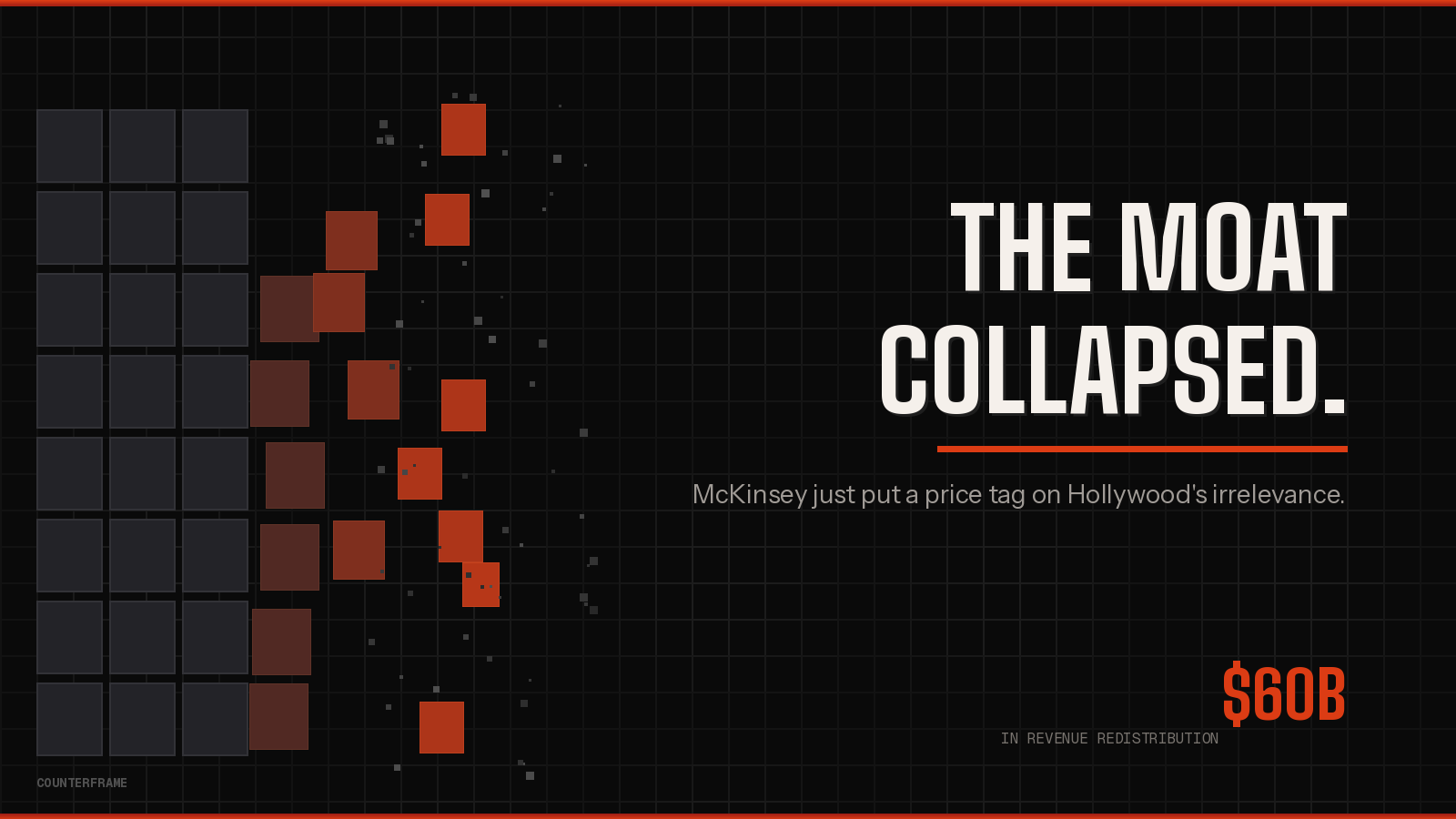
McKinsey just published a 14-page report telling the entertainment industry what we already knew: AI is going to restructure who gets to make content, how it gets made, and who profits from it.
The report is called “What AI could mean for film and TV production and the industry’s future.” It’s written for studio executives and distributors—the gatekeepers—helping them figure out how to protect their position in a world where the velvet rope is rotting.
But read between the consultantspeak, and what you actually find is a blueprint for the collapsed moat. Every data point McKinsey presents as a threat to incumbents is an opportunity for builders. They just didn’t write it for us.
So let’s translate.
The Number That Matters: $60 Billion
Here’s the headline buried under layers of careful hedging: McKinsey projects that up to $60 billion in annual revenue could be redistributed within five years of AI reaching mass adoption—if the pattern follows what happened when cinema replaced stage plays, streaming replaced linear TV, and short-form replaced long-form.
That’s not a prediction. It’s a historical pattern applied forward. Every major production and distribution technology shift over the last century has contracted incumbent revenue by an average of 35 percent within five years of wide adoption. Every single time.
The money doesn’t disappear. It moves. It moves to whoever built the new thing while the incumbents were still writing memos about it.
Seven Buyers Control 84 Percent of Spend
McKinsey drops this stat almost casually: in the United States, seven buyers account for 84 percent of content spending.
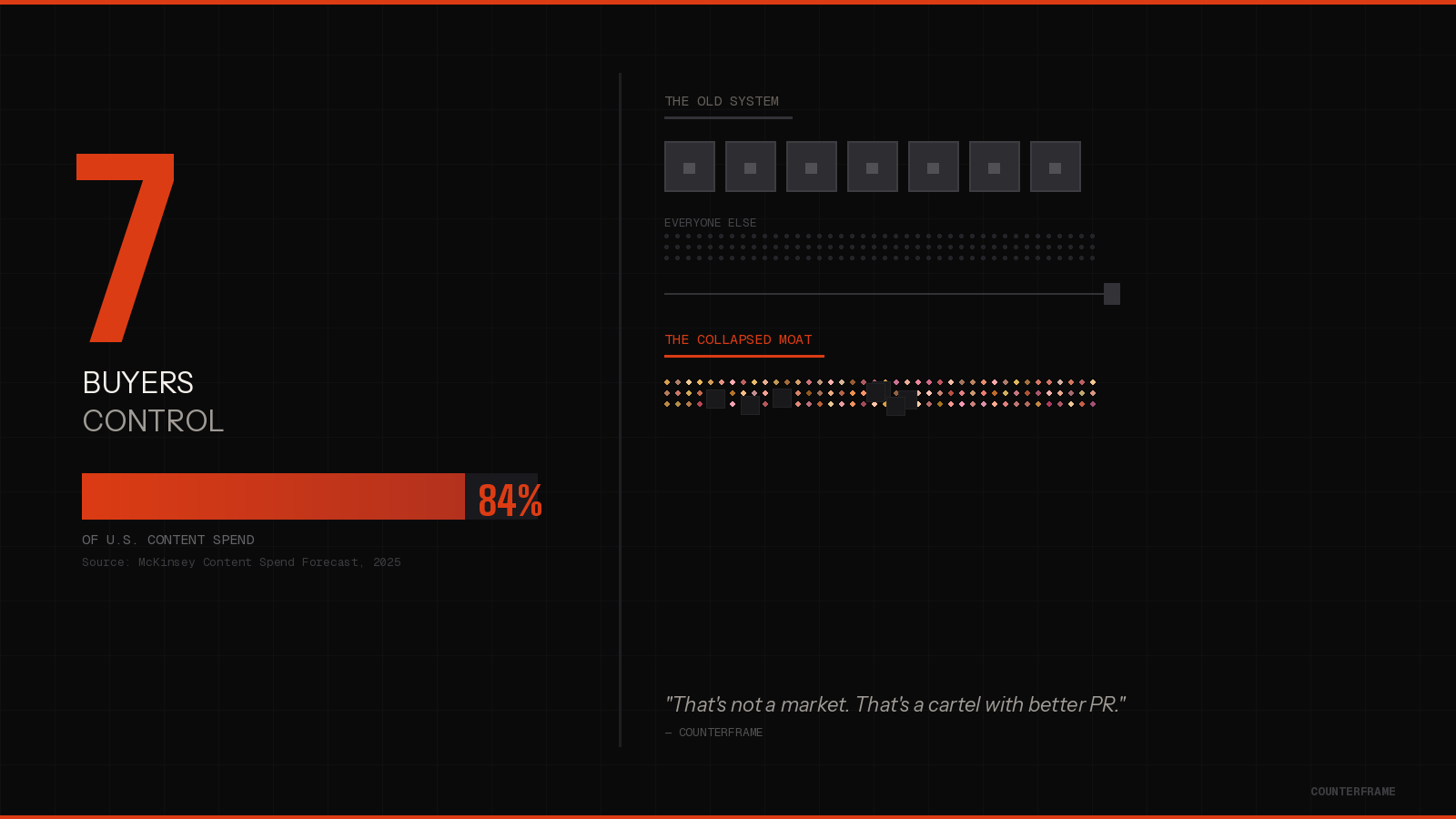
Read that again. Seven companies decide what gets made. Seven gatekeepers control the velvet rope for an entire industry. If your idea doesn’t fit what those seven entities want to buy, your idea sits in a drawer.
That’s not a market. That’s a cartel with better PR.
And it’s exactly the kind of concentration that gets shattered when production costs collapse. When it no longer costs millions to produce something that looks like millions, you don’t need to convince one of seven buyers to fund it. You need a laptop, the right tools, and something to say.
The Gatekeepers Are Already Losing Attention
The report documents what’s happening to viewership in real time. Linear TV viewership in the US declined by 4 percent annually from 2022 to 2024. Meanwhile, streaming grew by 13 percent and social video platforms grew by 14 percent. YouTube now accounts for 12.5 percent of all TV viewing time.
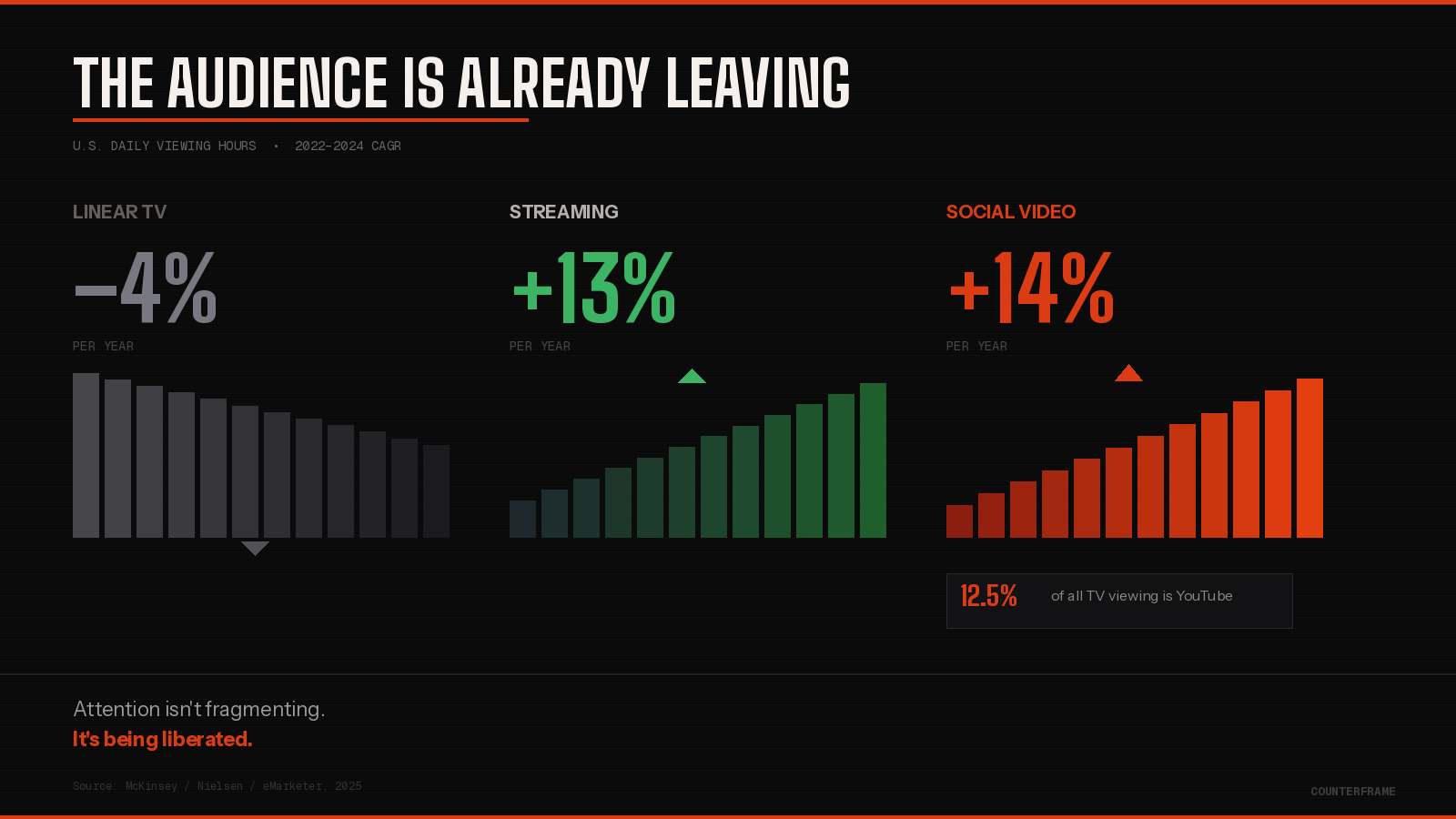
The audience is already leaving. They’re moving toward platforms where independent creators—not studios—set the agenda. The tools just haven’t fully caught up yet.
McKinsey frames this as a problem: consumer attention is “fragmenting.” That’s the gatekeeper’s word for losing control. From where the rest of us sit, attention isn’t fragmenting—it’s being liberated. People are choosing what they actually want to watch instead of choosing from what seven companies decided to make.
“Democratization” Is Their Word for It. Here’s Ours.
One of McKinsey’s three predicted outcomes is what they call the “wide-scale democratization of professional-grade content creation.” They note that AI could enable “smaller studios and creative entrepreneurs to compete more directly with large studios.”
We don’t call it democratization. We call it the collapsed moat.
For decades, the only way to produce something that looked and sounded professional was to go through the system—the studios, the agencies, the post-production houses with their six-figure budgets. That access was their moat. Not taste. Not vision. Access.
Now listen to what their own interviewees are telling them. George Strompolos, co-founder and CEO of Promise, told McKinsey: “You could say that the creator economy was about the democratization of distribution. This is about the democratization of production and creation itself.”
Distribution was step one. Production is step two. When both sides of the equation are open, the gatekeepers don’t have a function anymore. They’re middlemen in a world that just eliminated the middle.
The “Slop” Defense Won’t Save Them
McKinsey notes—and several studio executives emphasized—that current AI output doesn’t meet “premium production standards.” They worry about “AI slop.” They reassure themselves that quality remains a moat.
For now? Sure. But this is the same argument the music industry made about home recording in the 90s. It’s the same argument newspapers made about blogs in 2004. It’s the same argument network TV made about YouTube in 2008. The quality gap always closes. And it closes faster than incumbents expect.
The report itself documents the trajectory: producers are already seeing 5 to 10 percent productivity improvements in specific use cases, with pre-production leading the way. Leaders interviewed expect this to expand across physical production and post-production within five years. The quality floor is rising.
More importantly, the studios are confusing their own production standards with what audiences actually want. Audiences don’t care about your budget. They care about the story. They care about authenticity. They care about whether the thing holds their attention for six minutes or sixty.
A creator with the right idea and AI tools running at 80 percent of studio quality will beat a studio producing 100 percent quality content that nobody asked for. Ideas beat access. Every time.
The Historical Pattern They Can’t Ignore
McKinsey analyzed ten major technology innovations in content production and distribution. The lessons are devastating for incumbents if you read them honestly:
First cameras were only accessible to large professional studios. CGI expanded genres that only the biggest-budget players could afford. Every production technology that started as an incumbent advantage eventually became cheap enough for everyone—and when it did, the industry restructured.
New technologies always get adopted in unexpected ways. Early filmmakers treated the camera as a tool for recording stage plays. Television was supposed to broadcast lectures and live events. Mobile phone cameras were consumer curiosities before they created the short-form content ecosystem that now competes directly with Hollywood for attention.
Nobody—not the studios, not McKinsey, not anyone—can predict what creators will build when they have professional-grade production tools on a laptop. That’s the point. The whole history of media technology is the history of tools escaping the institutions that controlled them and landing in the hands of people who use them in ways nobody anticipated.
The New Platforms Are Already Emerging
The report mentions DreamFlare, a hybrid creation-and-distribution platform where creators publish AI-enhanced visual stories and audiences vote on which concepts get developed into full shows. That’s not a hypothetical future—that’s happening now.
This is the pattern: when creation gets cheap, new distribution emerges to match it. TikTok and CapCut already proved the model—creation tools and distribution combined in one environment, with near-zero-cost global reach. The next wave will do the same thing at higher production values.
Adrienne Lahens, CEO of Infinite Studios, told McKinsey: “Creators will move upstream as AI puts cinematic quality production tools in the hands of people who never had access to traditional Hollywood pipelines.”
That’s the whole ballgame in one sentence. Creators moving upstream. Not waiting for the pipeline to accept them. Building their own.
What McKinsey Wrote for Them—and What It Means for You
Here’s the translation table:
McKinsey says AI could address approximately $10 billion of forecast US original content spend by 2030. What that means for you: Billions in production work is about to be achievable at a fraction of the cost. The tools that gatekeepers used to justify their budgets are going to be available to anyone.
McKinsey says distributors are positioned to capture the majority of value from AI-driven workflow improvements. What that means for you: If you’re just a producer working for the existing system, the studios eat your efficiency gains. If you’re building your own platform and owning your distribution, you keep the value.
McKinsey says if open video platforms capture just 5 percent more of TV and film viewing hours, there’d be a $13.2 billion decline in traditional distribution revenues. What that means for you: Even a small shift in audience behavior creates massive disruption. You don’t need to beat Hollywood. You need to take five percent of their audience’s time.
McKinsey says “IP owners will have a relatively higher chance of success” because “their brands are more likely to cut through the noise.” What that means for you: Own your IP. Build recognizable brands. That’s what cuts through when there’s more content everywhere—not budgets, not studio logos, not distribution deals. Your brand. Your audience. Your relationship with them.
The Part They Won’t Say Out Loud
The McKinsey report is careful. It’s diplomatic. It acknowledges “concerns” and “uncertainties.” It notes that studios are suing AI companies over training data. It talks about ethical considerations and labor impacts and the importance of “human-led storytelling.”
All valid. All real. And all beside the point for you.
Because here’s what McKinsey won’t say out loud to the executives paying for their advice: the structural position of the gatekeeper is indefensible in a world where production tools are cheap and distribution is open. You can’t maintain a velvet rope when anyone can build their own venue.
The studios know this. That’s why they’re suing. That’s why they’re negotiating guild protections. That’s why they’re forming exclusive partnerships with AI companies. They’re not fighting to preserve quality or protect creativity—they’re fighting to preserve the moat.
And every historical precedent says the moat doesn’t hold.
So What Do You Do?
You build. That’s what you do.
You learn the tools—not as a tech enthusiast, but as someone with something to say who finally has the means to say it. You stop waiting for one of seven companies to greenlight your idea. You own your distribution. You build an audience that’s yours, not rented from an algorithm.
McKinsey just handed us the numbers. $60 billion in redistribution. 35 percent contraction for incumbents. Seven gatekeepers controlling 84 percent of a system that’s losing viewers by the year.
The consultants wrote that report for the people behind the velvet rope. But the data in it? That’s for us.
The moat collapsed. The tools caught up. The momentum is with the builders.
No gatekeepers. No permission. Just execution.
Jason Rink writes CounterFrame, the field guide for the populist content revolution. Subscribe for strategies, tools, and the occasional reminder that you don’t need their approval.