

I want to tell you a story about a film that wasn’t supposed to exist.
In 2021, I started making a documentary about January 6th. Not the version you’d seen a thousand times on cable news, but something that asked harder questions—questions that didn’t fit neatly into anyone’s approved narrative.
The major studios weren’t interested. Not because the footage wasn’t compelling. Not because the story wasn’t there. But because the perspective wasn’t approved. It wasn’t left-leaning enough for the gatekeepers who decide what America gets to watch.
So I made it anyway.
Then I got banned from social media. My accounts disappeared. My ability to promote my own work—gone.
Then came the federal investigations. The DOJ. The FBI. The IRS audit.
Four years of friction. Four years of being told, in every way the system knows how, that my ideas didn’t have permission to exist.
And then, on January 6th, 2025—four years to the day—”American Shaman” launched on Apple TV.
No studio. No permission. No gatekeepers.
This isn’t a story about politics
I know what you’re thinking. This is a conservative guy complaining about liberal media bias.
It’s not. Or at least, it’s not only that.
The political documentary was just one example of an unapproved narrative. The same gatekeeping system that blocked my film blocks a thousand other ideas every day—ideas that have nothing to do with politics.
The musician who doesn’t have a label connection. The writer who doesn’t have an agent in New York. The filmmaker who doesn’t have a producer with a Rolodex. The entrepreneur who doesn’t have VC friends from Stanford.
For decades, the creative economy had a velvet rope. The right connections. The right capital. The right zip code. If you didn’t have those things, your ideas died in your head—or worse, died in someone else’s inbox with a polite “not a fit for us right now.”
The gatekeepers didn’t just control distribution. They controlled permission. They decided whose voice mattered. Whose story got told. Whose vision got funded.
And most of us? We were supposed to just consume what they approved.
The tools finally caught up to the ethos
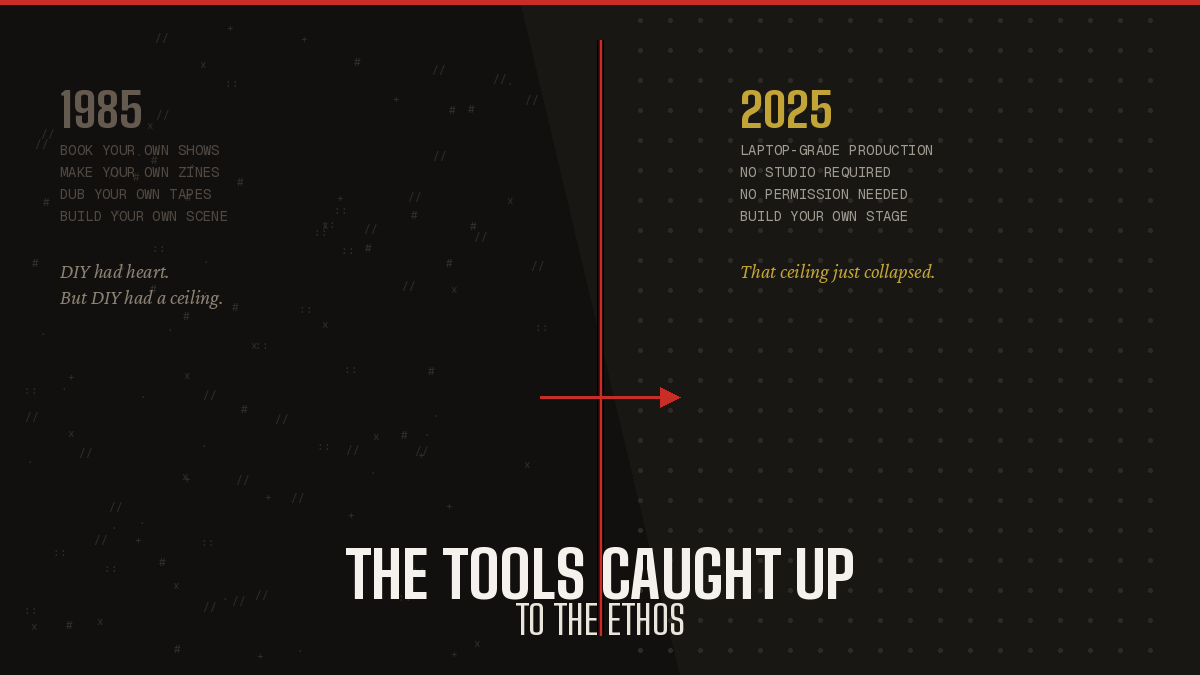
I’m GenX. I came up in the punk rock era—the DIY era. The whole point was that you didn’t wait for permission. You didn’t need a record label. You booked your own shows, made your own zines, dubbed your own tapes, built your own scene.
The ethos was always there. But the tools had limits.
You could book your own tour, but you couldn’t build your own MTV. You could print your own zine, but you couldn’t build your own publishing house. You could make your own short film, but you couldn’t match a studio’s production value—not without their budgets, their equipment, their crews.
DIY had heart. But DIY had a ceiling.
That ceiling just collapsed.
In the last two years, I’ve watched AI tools evolve from novelties to something that genuinely changes the game. Today, a single person with a laptop and an idea can produce content that would have required a full production team five years ago. Video. Music. Writing. Design. Animation. All of it.
The six-figure production budget? Optional.
The industry connections? Irrelevant.
The zip code? Doesn’t matter.
What matters now is the idea—and the willingness to execute.
The power shift is real
Here’s what I’ve realized after 15 years of going against the grain in this industry:
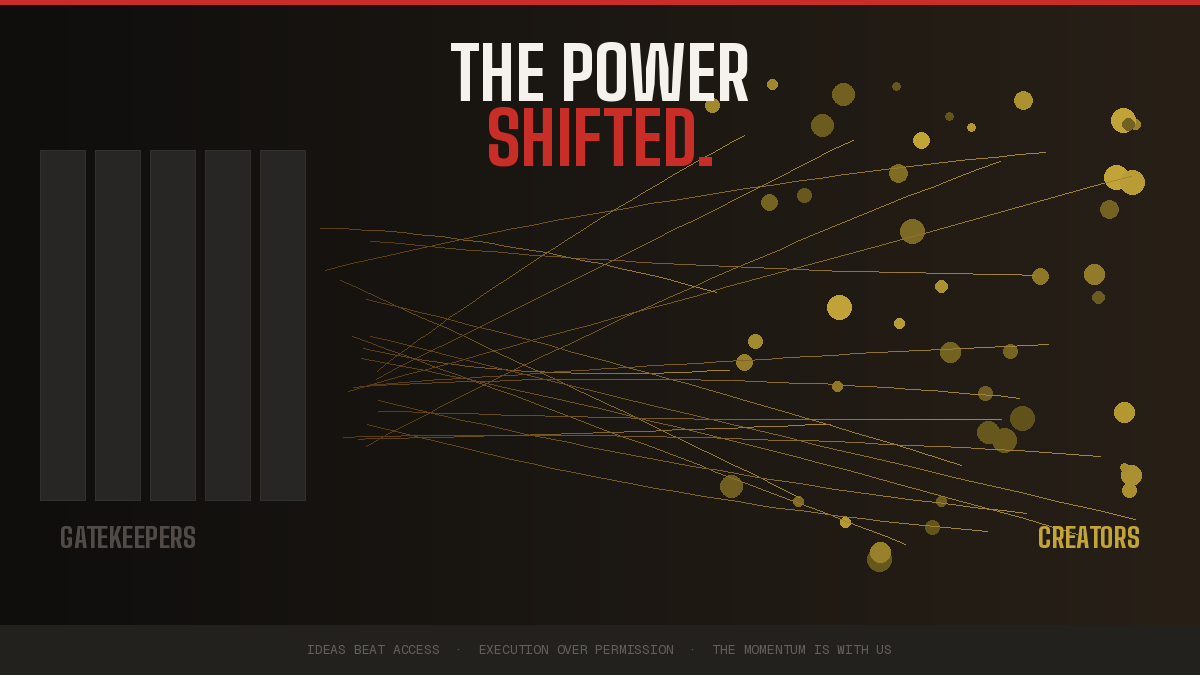
The gatekeepers never had better taste than the rest of us. They just had better access. Access to capital. Access to distribution. Access to the machinery that turns an idea into something millions of people can see.
That access was their moat. And AI just drained it.
The power is shifting—right now, in real time—from the gatekeepers cloistered in New York and Los Angeles to the tastemakers, curators, and creators building everywhere else.
The kid in Ohio with a YouTube channel and a vision. The writer in Arkansas who couldn’t get an agent’s attention. The musician in a small town who doesn’t know anyone in Nashville or LA. The filmmaker who got told “no” by every studio but kept shooting anyway.
These are the people who are going to define the next era of content. Not because they got permission. But because they don’t need it anymore.
This is a populist content revolution. And the momentum is with us.
What CounterFrame becomes now
I started CounterFrame as a political commentary newsletter. A place to share my films and push back against mainstream narratives.
But I’ve realized something: the real counter-frame isn’t about politics. It’s about power. Who has it. Who’s losing it. And how the rest of us can finally build without asking for permission.
So I’m relaunching CounterFrame with a new focus:
This is now the field guide for the populist content revolution.
I’m going to cover:
The tools that actually work. Not hype. Not vaporware. The AI tools and workflows that let a single creator produce at a level that used to require a team. I’ll show you what I’m using, what I’m testing, and what’s worth your time.
The strategies for building your platform. How to create content, build an audience, and own your distribution—without depending on algorithms or gatekeepers who can shut you off.
The mindset shift. The hardest part isn’t learning the tools. It’s unlearning the idea that you need permission. That someone else has to say yes before your idea can exist.
The case studies. I’ll find and break down the creators who are winning right now—the ones building real platforms, real audiences, real businesses—without traditional access.
This is for the people with ideas who’ve been told no. The people who’ve been ignored, shadowbanned, rejected, or just overlooked because they didn’t have the right connections.
You don’t need those connections anymore. You need a laptop, a vision, and the willingness to execute.
The punk rock playbook, upgraded
When I was a kid, punk rock taught me that you didn’t need a major label to matter. You didn’t need radio play. You didn’t need the industry’s blessing. You just needed to make the thing and find your people.
That ethos saved me. It’s why I kept making films when the studios said no. It’s why I kept going when I got banned, investigated, and audited. It’s why “American Shaman” exists at all.
But punk rock in 1985 had limits. You could go DIY, but you were always operating at a disadvantage. The major labels had resources you couldn’t match.
In 2025, that’s no longer true.
AI hasn’t just leveled the playing field—it’s tilted it toward the independents. The creators who are nimble, hungry, and willing to learn these tools are going to outmaneuver the slow, bloated, permission-based systems that have dominated for decades.
The gatekeepers had their turn.
Now it’s ours.
What’s next
If this resonates with you—if you’re someone with ideas who’s been waiting for permission that never came—subscribe.
I’m going to show you exactly how this new landscape works. The tools. The strategies. The workflows. Everything I’m learning as I build in this new era, I’m going to share here.
No gatekeepers. No permission. Just execution.
Let’s build.
Jason Rink writes CounterFrame, the field guide for the populist content revolution. Subscribe for strategies, tools, and the occasional reminder that you don't need their approval.