


A confession
I’ve been a professional creative for almost twenty years, and I never learned Photoshop.
I never learned After Effects either. I took typing in tenth grade and I still look at my hands. I’m looking at them right now, writing this.
I could have learned. But learning meant slowing down for a few weeks, and every single time, that cost felt too high. There was always something I wanted to make now.
That’s how I’ve handled every tool since. I learned Final Cut, then Premiere, because I had to, and I learned exactly as much of each as the job in front of me required.
I built a career on learning the fewest tools possible.
The ideas always came easily. The software never did. For two decades there was a gap between what I could see in my head and what my hands could get onto a screen.
I was one of the lucky ones. I got to make a living anyway.
Most people with that same gap never did. They had the song, the film, the comic, the strange little idea that wouldn’t leave them alone. Then they opened the software, hit the wall, and closed the laptop.
This is for them. The wall just came down.
They have a word for what happens next
The word is slop.
You’ve heard it. It gets thrown at anything made with AI: the image, the video, the song, the person who made it. It means you’re cheating. You’re stealing. You’re flooding the world with garbage.
This has happened before.
In April 1874, a group of young painters who couldn’t get into the official Paris Salon rented a photographer’s studio and put on their own show. A critic named Louis Leroy went to mock it for a satirical paper called Le Charivari.
He stopped in front of a hazy little painting of a harbor at sunrise. Claude Monet had titled it Impression, Sunrise. Leroy sneered that wallpaper in its embryonic state was more finished than that seascape, and he headlined his review “The Exhibition of the Impressionists.”
He meant it as a put-down. The painters kept the name anyway. Today Impressionism is probably the most beloved movement in the history of painting, and Leroy is mostly remembered for naming the people he was trying to bury.
A century later, “punk” was a dirty word. It meant a hoodlum, a delinquent, a worthless kid from the wrong side of town.
So in 1975, three kids in New York named their magazine Punk, precisely because it was the ugliest word they could find. They wrote about the Ramones, a band most of the scene considered a bad joke, and they got laughed at for years. Then, almost overnight, everything was punk.
They picked up an insult and wore it like a leather jacket.
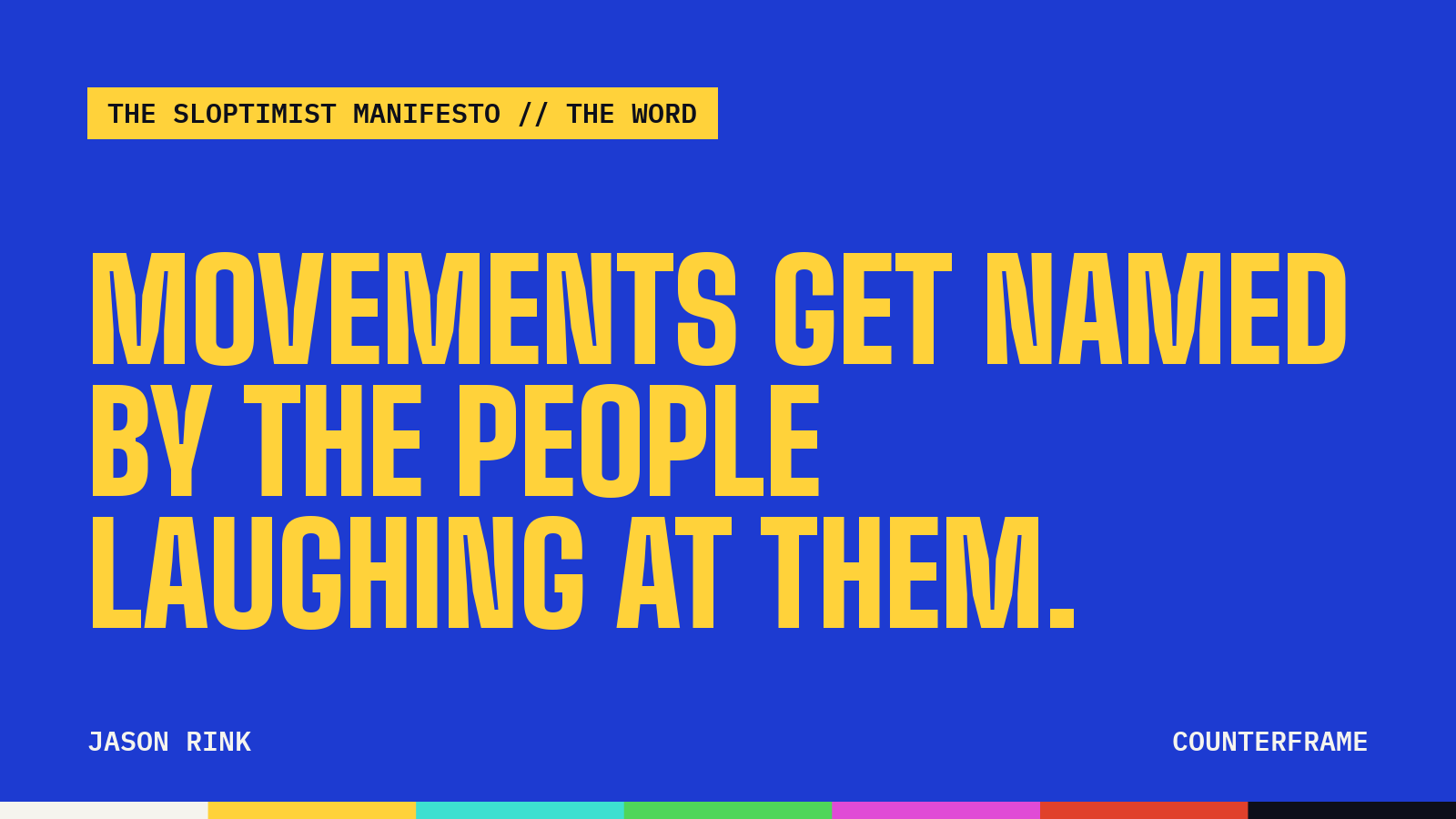
Movements get named by the people laughing at them. So I’ll take this one.
I am a Sloptimist.
“Slop” is a shaming word. It exists to make you feel embarrassed enough to stop.
A Sloptimist hears the shame and keeps the word anyway. Yes, I make slop. Proudly. What else have you got?
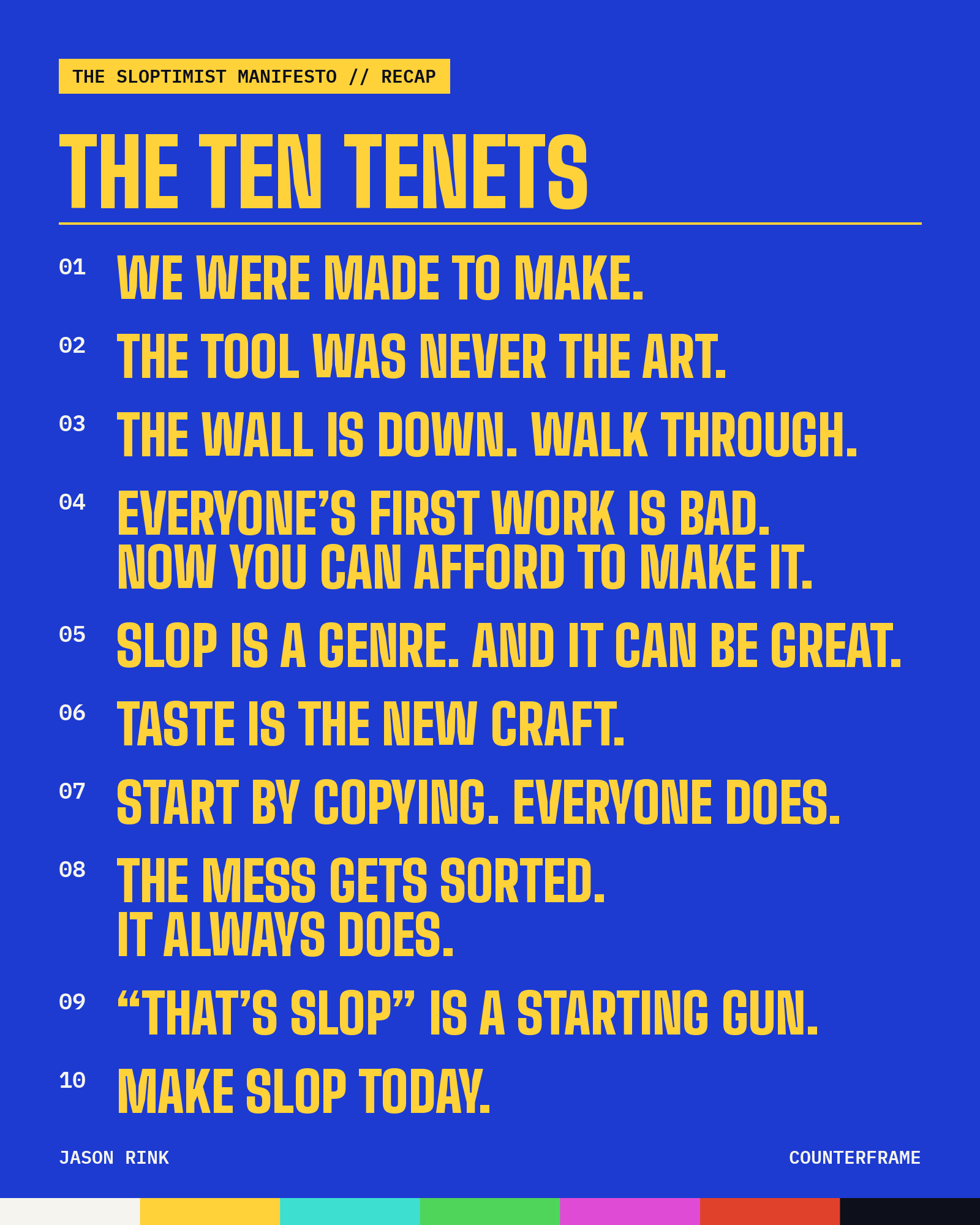
The ten tenets
1. We were made to make.
The impulse to create comes from somewhere beyond us.
You’ve felt it. The idea that shows up uninvited and won’t leave. The pull to make something that didn’t exist this morning. It was in you before anyone taught you anything.
Some of us have no idea where it comes from. Some of us call it the universe. Some of us call it God.
I’m in the last group, and my own tradition says it plainly. The first line of Genesis is “In the beginning God created the heavens and the earth.” Before you learn anything else about him, you learn that he makes things. Then it says we’re made in his image. The writer Dorothy Sayers noticed what that implies: at that point in the story, the only thing we know about the one whose image we carry is that he creates.
You don’t need my faith to see the pattern, though. Long before anyone wrote anything down, people were painting on cave walls. Every culture we’ve ever found sang, carved, built, and told stories.
Human beings have been answering that impulse for as long as there have been human beings.
2. The tool was never the art.
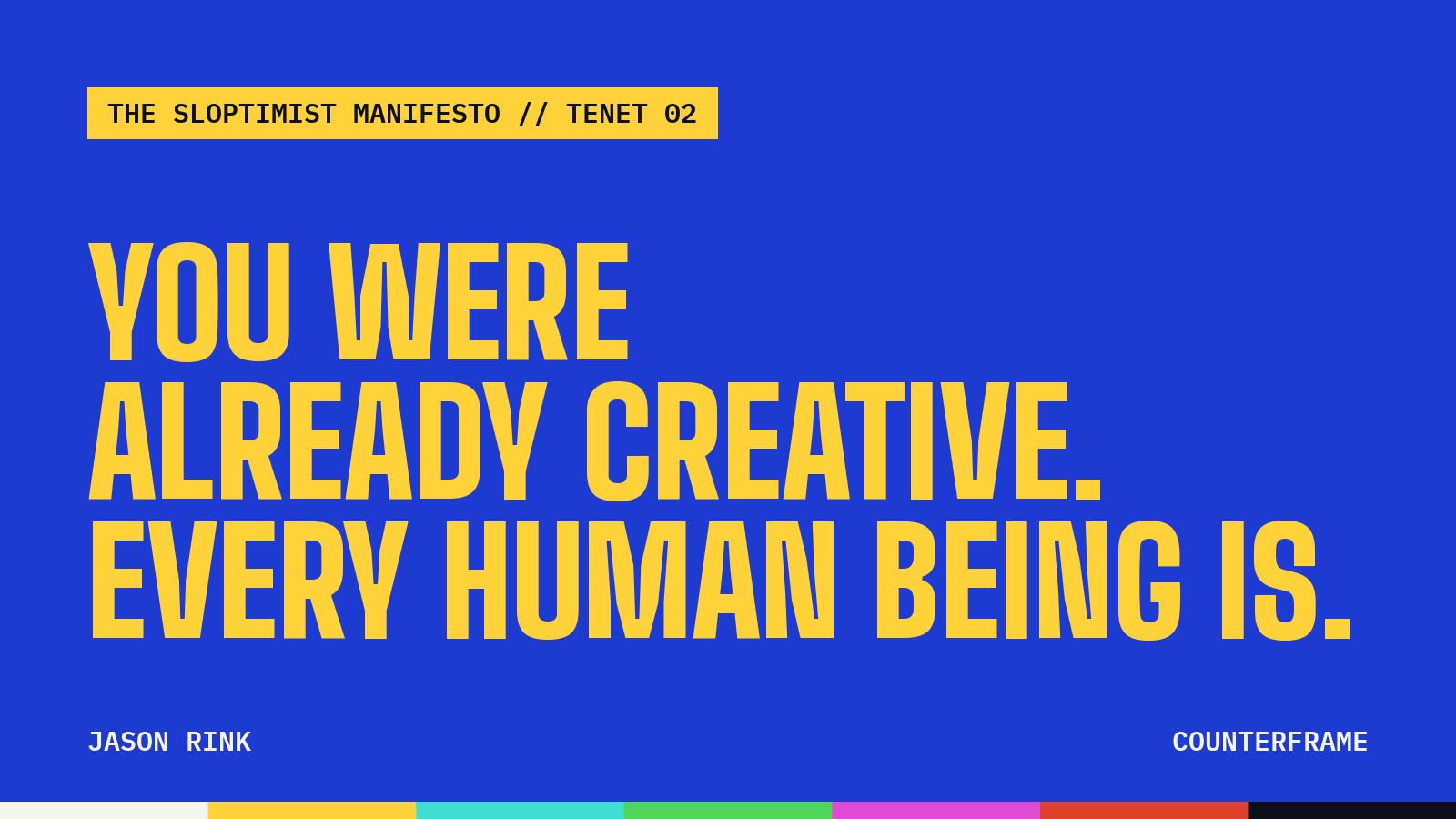
Mastering a tool won’t make you an artist, and it won’t make you creative. You were already creative. Every human being is.
A tool is a necessary obstacle, the path an idea has to travel to get out of your head and into the physical world.
And the path has always changed. Pencils. Paintbrushes. Musical instruments. Cameras that exposed an image onto a strip of negative.
I went to film school in 1992. I cut my first film on 16 millimeter, by hand, with a splicer and tape. A few years later nonlinear editing arrived and that whole skill set ended up in a museum.
The editors who moved to computers were still editors. They just had a new tool.
What’s different about AI is speed. We still have to learn these tools. But the distance between a creative idea and something real you can show someone has shrunk from years of training to days.
I think that’s good news. Making something real no longer depends on whether you could spare years to master the software.
For a long time we called the people who mastered the software “creatives” and everyone else “not creative.” That was always wrong.
3. The wall is down. Walk through.
Everyone is a creator at heart. Everyone.
The accountant who writes songs in the car and never plays them for anyone. The nurse with a graphic novel she’s been sketching in her head for fifteen years. The retired trucker who knows exactly what his movie would look like, shot for shot.
What they’re missing is one of two things: the opportunity, or the mastery. Maybe they never had the time, the money, the gear, or the room to fail. Or they had all of that, and the tools still asked for years they didn’t have.
So the idea stayed where it was. That’s the saddest kind of waste I know, and it happens every day, in every town, to people you know.
If you climbed the wall the hard way, I respect that. You earned every skill you have, and it’s still yours.
But the vision was always the point. Now a whole world full of untapped creators is about to walk through the gap, and they don’t owe anyone an apology for arriving after the wall fell.
4. Everyone’s first work is bad. Now you can afford to make it.
Every master has a drawer full of garbage. The early songs. The first script. The paintings no one will ever see.
Bad work is the road to good work. There’s no shortcut around it.
So make it anyway, then have the courage to publish it. Work that stays on your hard drive teaches you very little. Put it out where it can be judged. Then do it again. Then do it again.
The price is what’s changed. A thousand attempts used to cost a decade and a small fortune in gear and software. Now it costs a weekend.
5. Slop is a genre. And it can be great.
Slop can be bad. It can also be finished, funny, and exactly what it set out to be.
It’s becoming its own form: fast, strange, made for one moment of delight and gone by morning. Some people are already masters of it, and more are coming.
And if disposable entertainment offends you, I have news. We’ve been living on it for decades.
The networks and the streaming services have been serving lowest-common-denominator content to the broadest possible audience for as long as any of us have been alive. Polished, expensive, approved by committee, and saying nothing to anybody.
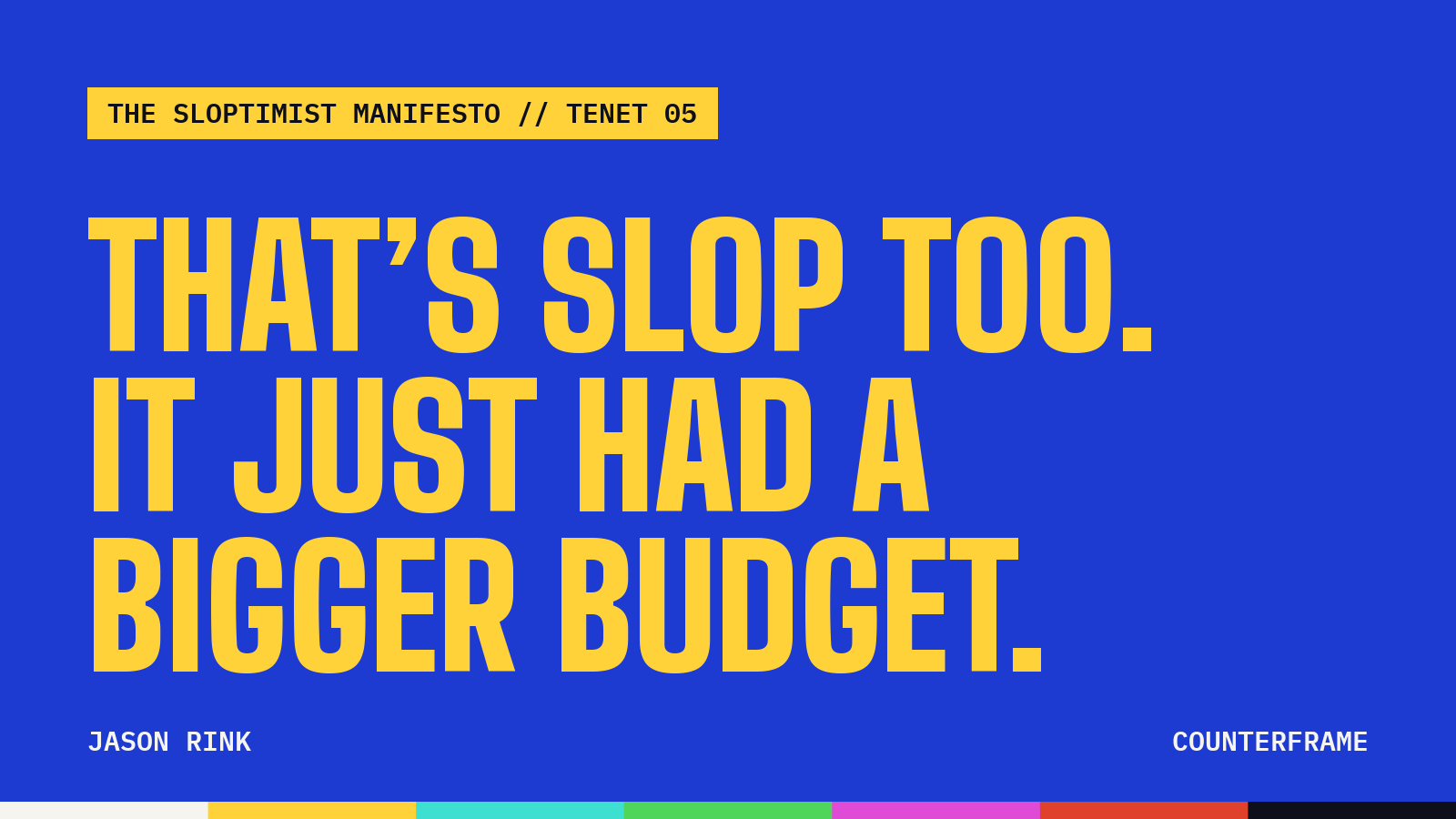
That’s slop too. It just had a bigger budget.
6. Taste is the new craft.
The critics say AI makes it easy. I’d invite them to try making something good with it.
Type a prompt and you’ll get something back in seconds. It’ll usually be fine, and that’s the trap. Left alone, the machine hands you the middle of everything it has ever seen: the most average sunset, the most average song, the most average joke. Most of the bland AI work you’ve scrolled past came from someone who stopped at the first answer.
Taste is what pulls the work off that middle. It’s knowing what you’re after before you see it, recognizing it when it shows up, and having the nerve to throw away thirty-nine versions that are almost right.
That was always the real job. A director doesn’t run the camera. An editor doesn’t shoot the footage. Their value is judgment: this take, cut here, that’s done. I’ve spent twenty years getting paid for exactly that, while knowing as little software as I could get away with.
The hard part has moved. Getting the thing onto the screen is quick now. Knowing which of the forty versions is the right one, and why, still takes years.
AI speeds that up too. Developing an eye used to mean waiting weeks to find out if an idea worked. Now you can line up forty versions in an afternoon and train your eye on every one of them.
That judgment only comes from reps. See tenet four.
7. Start by copying. Everyone does.
Remember how you learned to draw? You copied. A cartoon character, a comic book cover, the logo of your favorite band. Almost everyone starts with something they love and works toward something of their own.
The same thing is happening right now with AI. People are making memes out of scenes from The Office. They’re remixing Rick and Morty. They’re bringing old jokes to life.
The critics see theft. I see a few million people picking up a pencil for the first time.
When you’ve gone your whole life without using your creative voice, it’s hard to know where to begin. So you begin with what you know. That’s the door. Go through it.
Remix culture is the grown-up version of this, and it started at a party.
On August 11, 1973, an 18-year-old DJ named Clive Campbell, better known as Kool Herc, played his sister’s back-to-school party in the rec room of their apartment building in the Bronx. He’d grown up in Kingston, Jamaica, around sound-system parties where the DJ was the star.
Herc had noticed the crowd went wildest during the short drum breaks in funk records. So he put two copies of the same record on two turntables and switched back and forth, stretching a few seconds of James Brown into minutes. He didn’t write a note of it. He found the best part of somebody else’s record and made it last.
That was the beginning of hip hop. Sixteen years later, the Beastie Boys released Paul’s Boutique, an album stitched together from a staggering pile of other people’s records. It sold poorly and confused critics. Today it’s treated as a masterpiece.
Hip hop built an entire art form out of other people’s records and was called theft the whole way up. It went on to become the dominant music of the next forty years. AI is that moment for visual media.
Copy to learn. Remix to play. Then keep going until what comes out could only have come from you.
8. The mess gets sorted. It always does.
Sampling went through the courts, and it got ugly. In 1991 Biz Markie was sued for sampling a Gilbert O’Sullivan song. Judge Kevin Duffy opened his ruling with “Thou shalt not steal” and referred the case for possible criminal prosecution.
Biz named his next album All Samples Cleared! What came out of that fight was a system where the people being sampled got paid, and the art form kept growing.
The same fight is happening now between artists and the AI labs, in lawsuits, settlements, and licensing deals. That’s where it belongs. The labs trained the models. The kid making a short film in her bedroom didn’t.
We hope the artists get what they’re owed. We also refuse to sit out the most important creative shift of our lifetime while the lawyers work.
9. “That’s slop” is a starting gun.
When someone calls your work slop, they’re trying to shame you out of making the next one.
But look at what they’ve actually told you. You made something, and it reached them. Most people never get that far.
Notice how little the word says, too. “Slop” is a verdict with no reasons attached. It won’t tell you the pacing dragged, the voice sounded off, or the joke landed a beat late. Real criticism names something you can fix. When you get that kind, take it, and say thank you.
When all you get is the label, let it roll off. Leroy said worse to Monet. A federal judge called Biz Markie a thief in writing. They both kept working, and history remembers the work.
Skip the argument in the comments. Answer with the next piece, posted a week later and a little better than the last.
10. Make slop today.
Then make some more tomorrow.
What happens now
Think about how many people have carried an idea around for ten or twenty years because they couldn’t get past the software.
Now picture all of them starting at once.
A lot of what they make at first will be rough. Some of it will be embarrassing. Plenty of it will get called slop by people who’ve forgotten their own first drafts.
And somewhere in that flood is a filmmaker who never touched a camera, a songwriter who can’t read music, an illustrator who can’t draw a straight line. They’re a few hundred attempts away from making something none of us have seen before.e.
So make the thing. Make slop. Put your name on it and hit publish.
Welcome to the movement. We’re glad you made it in.
If this is you, subscribe to CounterFrame and make slop with me.